
Healthcare organizations increasingly depend on websites, appointment systems, patient portals, databases, staff applications, and other digital services. These systems need hosting infrastructure that can provide reliable performance, appropriate security controls, and enough flexibility to grow with the organization.
VPS hosting for healthcare provides an isolated virtual server environment with defined computing resources and greater administrative control than conventional shared hosting. Hospitals, clinics, diagnostic laboratories, telemedicine providers, and home nursing companies can use VPS infrastructure for suitable websites, business applications, databases, and internal systems.
However, choosing a VPS for healthcare involves more than comparing CPU, RAM, and storage. Security, backups, access control, availability, server location, application requirements, and applicable privacy or regulatory obligations should all be considered.
Important: A VPS is infrastructure, not a complete healthcare security solution. A properly configured VPS can support appropriate security controls, but the organization must also secure its operating system, applications, databases, user accounts, and data.
What Is VPS Hosting for Healthcare?
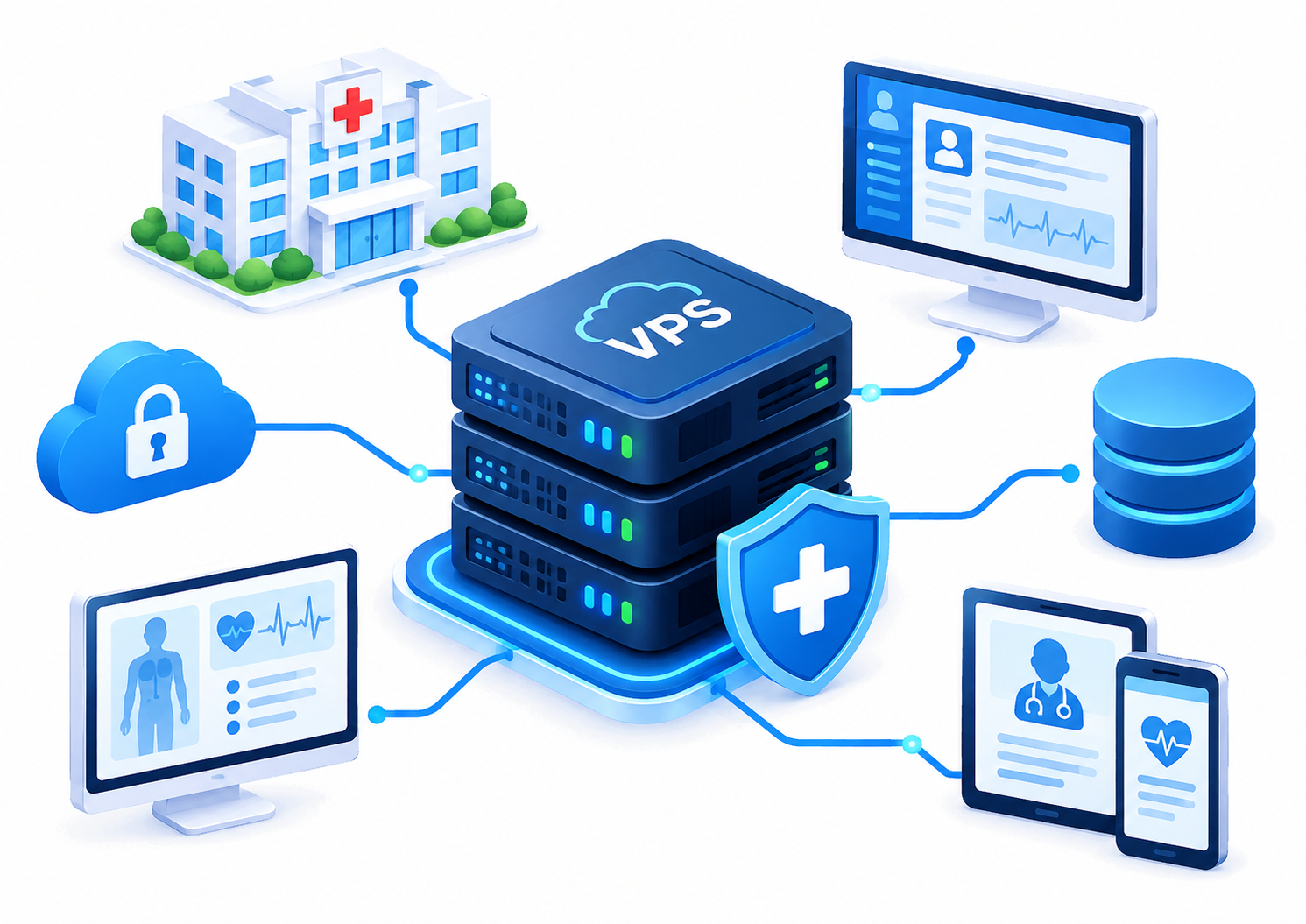
VPS hosting for healthcare means using a Virtual Private Server (VPS) to host websites, applications, databases, portals, or other digital systems used by healthcare organizations.
A physical server is divided into isolated virtual environments. Each VPS operates as an independent virtual server with allocated resources and its own operating system and configuration.
Depending on the hosting platform, a VPS gives organizations control over areas such as:
- CPU and RAM allocation
- Storage configuration
- Operating system
- Web server and database software
- Firewall rules
- User permissions
- Application dependencies
- Backup configuration
- Monitoring tools
The exact performance characteristics depend on the virtualization technology and hosting provider. A VPS provides an allocated virtual environment, but that does not necessarily mean every underlying physical CPU resource is exclusively dedicated to one customer.
Why Healthcare Organizations Use VPS Hosting
Healthcare businesses often depend on systems that need to remain accessible to patients, healthcare professionals, administrative staff, and other authorized users.
A VPS can be useful when an organization needs more resources or configuration flexibility than shared hosting provides.
Allocated Server Resources
A VPS provides defined virtual resources such as CPU, RAM, storage, and network capacity.
This can provide more predictable resource allocation than a heavily shared hosting environment.
The appropriate configuration depends on the application. A small clinic website may need far fewer resources than a multi-user healthcare management application or database.
Greater Server Control
Healthcare applications may require specific software, databases, server configurations, or security settings.
A VPS gives administrators greater control over the hosting environment, including:
- Operating system configuration
- Web server settings
- Database software
- Firewall rules
- User permissions
- Security tools
- Monitoring
- Backup systems
Organizations without experienced server administrators may consider managed VPS hosting, provided they clearly understand which responsibilities are handled by the provider and which remain with the customer.
Scalability
Healthcare organizations can grow by adding patients, staff, branches, services, or applications.
A VPS can be scaled when resource requirements increase. However, resources should be selected based on actual workload measurements rather than simply choosing the largest available plan.
Healthcare Applications That Can Run on a VPS
A VPS can support many healthcare-related workloads when the application architecture, security controls, and applicable requirements have been properly evaluated.
Examples include:
- Healthcare organization websites
- Appointment booking systems
- Staff portals
- Patient management applications
- Scheduling systems
- Administrative dashboards
- Telemedicine applications
- Healthcare databases
- Billing applications
- Laboratory management applications
- Home nursing management systems
Applications that process sensitive health or personally identifiable information require additional security and compliance consideration.
A VPS itself does not make an application compliant with healthcare privacy regulations. Compliance depends on the complete technical, organizational, contractual, and operational environment.
VPS Hosting for Hospitals
Hospitals may operate multiple digital systems for patients, doctors, nurses, administrative teams, and other departments.
Depending on the architecture, VPS infrastructure may be suitable for websites, portals, supporting applications, administrative systems, or other workloads that fit the capabilities of the environment.
Hospitals should evaluate:
- Availability requirements
- Backup architecture
- Disaster recovery
- Access controls
- Monitoring
- Data protection
- Application dependencies
- Regulatory requirements
A single VPS can become a single point of failure. Highly critical clinical workloads may therefore require redundant infrastructure, specialized platforms, or high-availability architectures rather than relying on one VPS.
VPS Hosting for Clinics
Clinics often need reliable digital infrastructure without maintaining physical servers themselves.
A VPS can host clinic websites and appropriate web-based applications such as:
- Appointment systems
- Scheduling applications
- Staff portals
- Administrative systems
- Business databases
- Patient communication platforms
A smaller informational clinic website may not need a VPS. The decision should be based on traffic, application requirements, security needs, and resource usage.
VPS Hosting for Diagnostic Laboratories
Diagnostic laboratories may use digital systems for appointments, administration, reporting, and workflow management.
A properly configured VPS may support laboratory websites, appointment systems, reporting portals, databases, and other suitable applications.
Where patient information is involved, organizations should pay particular attention to access control, encryption, backups, auditability, application security, and applicable privacy requirements.
VPS Hosting for Telemedicine
Telemedicine platforms can depend on websites, databases, APIs, authentication systems, scheduling applications, and communication services.
A VPS can provide infrastructure for suitable components of a telemedicine platform when the application’s resource and security requirements are properly assessed.
Real-time video consultation services can have significantly different infrastructure requirements from a normal website. Bandwidth, latency, concurrent users, geographic server location, and application architecture should therefore be evaluated before choosing a VPS.
VPS Hosting for Home Nursing Services
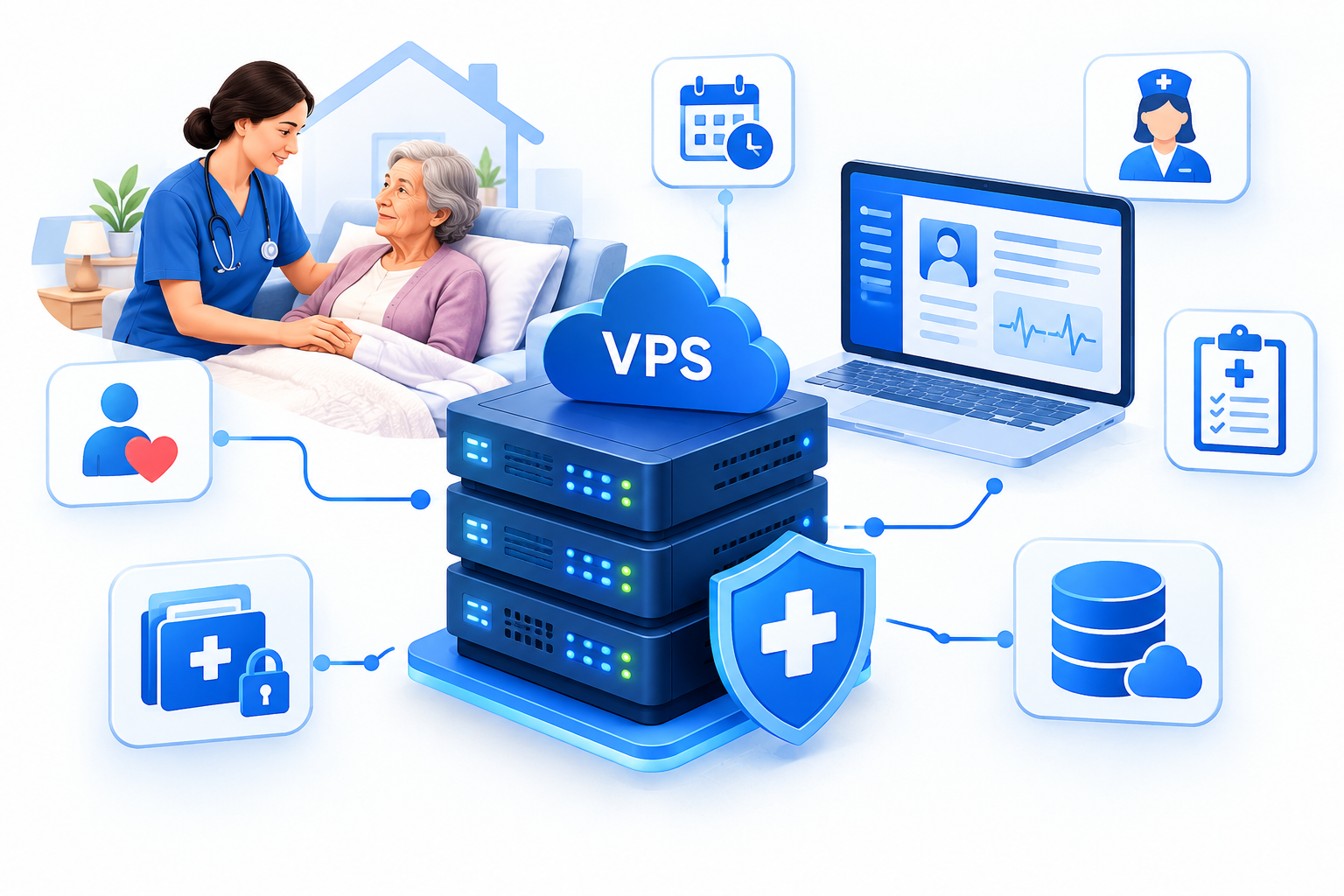
Home nursing providers increasingly depend on digital systems to coordinate patients, caregivers, appointments, schedules, and administrative operations.
A VPS for home nursing services can provide infrastructure for websites and business applications while giving the organization greater control over server resources and configuration.
A home nursing organization may use VPS hosting for:
- Home nursing websites
- Online patient inquiry forms
- Appointment management
- Nurse and caregiver scheduling
- Staff portals
- Administrative dashboards
- Care coordination systems
- Internal business applications
- Business databases
- Online service-request systems
For example, a growing home nursing company may have caregivers working at different patient locations while office staff coordinate schedules from a central location. A web-based scheduling or management application can allow authorized employees to access the information they need without maintaining separate systems at every location.
If such applications contain patient information, the organization should implement appropriate safeguards around authentication, permissions, encryption, backups, monitoring, and data handling.
The VPS provides the infrastructure; the security of the complete application environment still depends on how that infrastructure and the application are configured and managed.
VPS Hosting for Healthcare Websites
Not every healthcare organization needs a complex application.
Many healthcare businesses primarily need a fast, reliable website containing:
- Service information
- Doctor or specialist profiles
- Branch information
- Appointment forms
- Patient resources
- Contact forms
- Online booking
A VPS can be appropriate when a healthcare website has outgrown shared hosting, requires additional resources, uses resource-intensive applications, or needs greater server-level configuration control.
For a small informational website with modest traffic, shared hosting may remain sufficient.
Security Considerations for Healthcare VPS Hosting
Security should be considered at multiple layers.
A VPS can provide isolation and administrative control, but it does not automatically secure the applications or information running inside it.
Important controls may include:
- Keeping the operating system and applications updated
- Restricting administrative access
- Using strong authentication
- Applying appropriate firewall rules
- Encrypting sensitive data where appropriate
- Using secure connections for data transmission
- Applying least-privilege access
- Monitoring server activity
- Maintaining appropriate logs
- Performing regular backups
- Testing backup restoration
- Removing unnecessary services and software
For healthcare environments, security should address the confidentiality, integrity, and availability of sensitive information. For organizations subject to HIPAA, HHS identifies administrative, physical, and technical safeguards as part of the Security Rule.
For detailed server configuration procedures, link this section to a dedicated VPS Server Hardening Guide rather than turning this article into a complete security tutorial.
Understand the Shared Security Responsibility
One of the most important points when choosing VPS hosting for healthcare is understanding who is responsible for each layer of security.
The hosting provider may be responsible for areas such as:
- Physical infrastructure
- Data-center security
- Host infrastructure
- Virtualization platform
- Provider network infrastructure
- Provider-level availability
The customer may be responsible for areas such as:
- Operating system configuration
- User accounts
- Passwords and authentication
- Application security
- Database configuration
- Access permissions
- Software updates
- Data management
- Backup policies
The exact division depends on the hosting arrangement and services purchased.
For healthcare workloads, these responsibilities should be clearly established before deployment.
For HIPAA-regulated environments, HHS guidance specifically notes that security responsibilities between a cloud service provider and customer can depend on the services and contractual arrangements involved.

Backups and Disaster Recovery
Healthcare organizations should never treat the live VPS as their only copy of important information.
Server failure, human error, application problems, malware, ransomware, or accidental deletion can make independent backups essential.
A sensible backup strategy may include:
- Automated backups
- Multiple backup copies
- Offsite backup storage
- Appropriate retention periods
- Backup encryption where appropriate
- Backup verification
- Regular restore testing
Organizations should also define two important recovery targets:
Recovery Point Objective (RPO): How much recent data the organization can afford to lose after an incident.
Recovery Time Objective (RTO): How quickly the application or service needs to be restored.
For example, a system with a very low RPO and RTO will generally require a more robust backup and recovery architecture than a basic informational website.
HHS cloud guidance also identifies availability, backup, and data recovery as considerations that may need to be addressed in healthcare cloud arrangements.
For detailed backup practices, link to dedicated resources such as Offsite VPS Backups, VPS Backup Verification, and VPS Disaster Recovery.
Availability and Reliability
Some healthcare applications need to remain available throughout the day.
Before choosing a VPS, determine how much downtime the organization can tolerate and what happens if the server becomes unavailable.
Consider:
- Infrastructure reliability
- Network connectivity
- Storage reliability
- Server monitoring
- Backup availability
- Recovery procedures
- Technical support
- Application redundancy
A single VPS may not provide sufficient redundancy for a highly critical healthcare application.
Organizations with strict availability requirements may need additional infrastructure such as redundant servers, replicated databases, load balancing, or failover systems.
Choosing VPS Resources for Healthcare Applications
There is no universal VPS specification for healthcare organizations.
A small healthcare website and a multi-user healthcare management application can have completely different requirements.
CPU
Applications with many simultaneous users, database queries, or background processes may require additional processing capacity.
RAM
The operating system, database, web server, application, caching systems, and other services all consume memory.
Storage
Consider both storage capacity and storage performance, especially when applications depend heavily on databases.
Bandwidth
Websites, APIs, downloads, remote users, media, and telemedicine applications can increase bandwidth requirements.
Server Location
Server location can affect network latency and may also matter for data-residency, contractual, or organizational requirements.
The best approach is to monitor actual usage and increase resources when workload requirements justify it.
Managed vs Unmanaged VPS for Healthcare
An unmanaged VPS generally leaves server administration to the customer. This can include operating-system maintenance, security configuration, monitoring, troubleshooting, and software management.
This approach may suit organizations with experienced system administrators.
A managed VPS can be useful for healthcare organizations that do not have dedicated server-management expertise.
However, managed hosting does not automatically transfer responsibility for application security, patient-data handling, privacy obligations, or regulatory compliance to the hosting provider.
Before purchasing managed VPS hosting, clarify:
- What the provider manages
- What the customer manages
- Whether operating-system updates are included
- What security monitoring is provided
- What backup services are included
- What support is available during an incident
Healthcare Data Privacy and Compliance
Healthcare organizations can be subject to different privacy, cybersecurity, medical-data, and data-residency requirements depending on where they operate, what information they process, and which services they provide.
Therefore, organizations should determine:
- What type of information will be stored
- Where the data will be hosted
- Who can access it
- How users are authenticated
- Where backups are stored
- How sensitive information is protected
- Which laws and contractual requirements apply
- What happens to data when the hosting service ends
What About HIPAA?
HIPAA applies to covered entities and business associates within its scope; it is not a universal healthcare hosting standard for every country.
For organizations subject to HIPAA, HHS states that a cloud service provider handling ePHI on behalf of a covered entity or business associate can be a business associate, and the appropriate business associate agreement and applicable HIPAA requirements must be addressed.
Therefore:
VPS hosting does not automatically make a healthcare application HIPAA compliant.
Compliance depends on the complete environment, including the hosting arrangement, contracts, risk analysis, security controls, applications, access management, policies, and operational practices.
Healthcare organizations outside the United States should evaluate the privacy and data-protection requirements applicable in their own jurisdiction.
What to Check Before Choosing a Healthcare VPS Provider
Before deploying a healthcare workload, ask the hosting provider questions such as:
- Where is the VPS infrastructure located?
- What backup options are available?
- Are backups stored separately from the VPS?
- What level of technical support is provided?
- How is infrastructure availability monitored?
- What security controls are provided at the infrastructure level?
- What responsibilities remain with the customer?
- Can resources be scaled when requirements increase?
- What happens if the VPS becomes unavailable?
- What contractual or compliance documentation is available?
- If HIPAA applies, can the required contractual arrangements be supported?
The answers should be evaluated according to the sensitivity and criticality of the application rather than simply choosing a provider based on price.
Common Mistakes When Hosting Healthcare Applications on a VPS
Several mistakes can undermine an otherwise suitable hosting environment.
Assuming a VPS Is Automatically Secure
A VPS provides infrastructure and control. It does not automatically secure the applications, accounts, databases, or data stored on it.
Keeping the Only Backup on the VPS
If the VPS becomes unavailable or compromised, a backup stored on the same environment may not provide adequate recovery protection.
Giving Users Excessive Access
Users should receive only the permissions necessary for their roles.
Delaying Security Updates
Unpatched operating systems, applications, plugins, and server software can introduce avoidable security risks.
Never Testing Restoration
A successful backup job does not prove that the data can actually be restored. Periodic restore testing is essential.
Choosing Resources Without Monitoring
Selecting a large VPS without understanding actual workload requirements can increase costs without solving the underlying performance problem.
Ignoring the Application Layer
A secure server cannot compensate for an insecure application. Vulnerable code, weak authentication, poor access control, or insecure database configuration can still expose sensitive information.
Real-World Healthcare VPS Scenarios
The appropriate VPS configuration depends on the workload.
Small Clinic
A small clinic might use a VPS for its website, appointment system, and internal staff portal.
Home Nursing Company
A home nursing provider might host its website, caregiver scheduling system, appointment management application, and staff dashboard on a VPS.
Diagnostic Laboratory
A laboratory might use VPS infrastructure for its website, appointment platform, reporting portal, and administrative applications.
In each case, the VPS requirements should be determined from the actual application architecture, number of users, traffic, data sensitivity, availability requirements, and security controls.
When Does VPS Hosting Make Sense for a Healthcare Organization?
VPS hosting may make sense when an organization needs more resources, flexibility, or server-level control than conventional shared hosting provides.
It can be particularly relevant when:
- A healthcare website has outgrown shared hosting
- A custom application requires specific server configurations
- The organization needs defined virtual resources
- Multiple employees access web-based applications
- The organization needs greater control over security settings
- Databases or applications are becoming more resource-intensive
- The organization expects its infrastructure requirements to grow
A VPS may not be the right architecture for every healthcare workload. The decision should be based on the application’s requirements, sensitivity of the information, availability needs, technical expertise, and applicable regulatory obligations.
Frequently Asked Questions
