
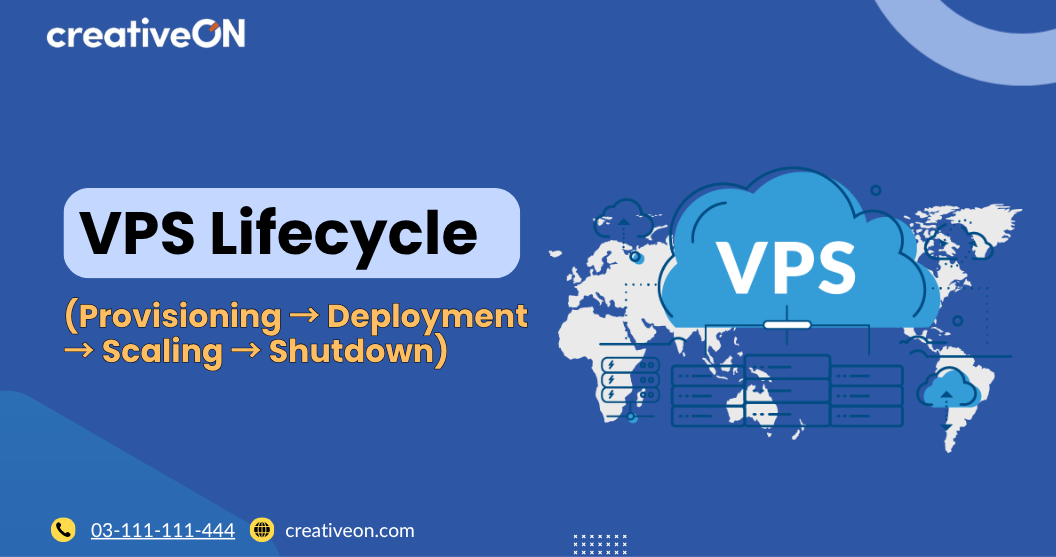
A VPS lifecycle is not just a sequence of steps—it is a controlled infrastructure state machine inside a virtualization layer. Every virtual server passes through predictable system states where resources are assigned, activated, adjusted, and eventually released.
Understanding this lifecycle helps you interpret how hosting infrastructure behaves behind the scenes, from initial VM creation to final deallocation.
1. VPS Provisioning (Virtual Machine Instantiation State)
Provisioning is the stage where a virtual machine is created inside the hypervisor environment and bound to physical compute resources.
At this point, the VPS does not yet serve traffic. Instead, it exists as a configured system instance waiting for initialization.
System-Level Behavior
- A VM instance is instantiated on a physical node
- vCPU threads are assigned from the host scheduler
- Memory pages are reserved within the hypervisor pool
- Disk volume is attached from storage backend (SSD/NVMe layer)
- A base OS image is cloned or mounted
State Transition Trigger
Provisioning ends when the system reaches a bootable VM state, meaning the kernel can be executed.
👉 This stage is conceptually tied to infrastructure resource allocation logic (see VPS resource allocation architecture guide).
2. VPS Deployment (Active Runtime Initialization State)
Deployment begins when the provisioned virtual machine is powered on and begins executing its operating system environment.
This is where the VPS transitions from “allocated instance” to “active server environment.”
System-Level Behavior
- Hypervisor initiates VM boot sequence
- Kernel loads into allocated memory space
- Network interface becomes reachable
- Initial system services start execution
- Control layer (if present) activates management access
State Transition Trigger
Deployment is considered complete when the system reaches network-ready runtime state, meaning external connections can reliably access the server.
👉 Deployment is separate from configuration tuning or security hardening (handled in dedicated clusters).
3. VPS Scaling (Resource Reallocation State)
Scaling occurs when the VPS requires adjustment of allocated resources due to workload changes.
Unlike provisioning and deployment, scaling is not a one-time phase—it is a dynamic state transition triggered by infrastructure-level demand shifts.
System-Level Behavior
- CPU allocation is increased or rebalanced at hypervisor level
- Memory limits are adjusted within VM boundaries
- Storage capacity is expanded or reattached
- In some cases, VM migration to a stronger host node occurs
State Transition Trigger
Scaling is triggered when the system enters a resource reallocation state, where existing allocation is no longer sufficient or needs optimization.
👉 This connects structurally to VPS scaling behavior models (see Scaling Cluster).
4. VPS Shutdown (Deallocation & Resource Release State)
Shutdown is the final stage where the virtual machine is gracefully stopped and removed from active infrastructure scheduling.
This stage ensures that compute resources are safely returned to the hosting pool.
System-Level Behavior
- VM process is gracefully terminated
- Memory pages are released back to hypervisor pool
- CPU scheduling slots are freed
- Disk state is preserved, archived, or deleted based on policy
- VM record is removed from active registry
State Transition Trigger
Shutdown completes when the VM enters a deallocated infrastructure state, meaning it no longer consumes active compute resources.
VPS Lifecycle State Model (Core Concept Layer)
The VPS lifecycle can be understood as a controlled state machine:
- Provisioned State → VM exists but is not active
- Bootable State → VM is ready for execution
- Active Runtime State → Server is operational
- Resource Reallocation State → Scaling is applied
- Deallocated State → System resources are released
This model is essential for understanding VPS behavior beyond surface-level hosting concepts.
Internal Linking Opportunities
This lifecycle connects to multiple specialized VPS system nodes:
- VPS resource allocation architecture (Provisioning layer mechanics)
- VPS scaling behavior system (Resource reallocation logic)
- VPS performance bottleneck analysis (runtime resource effects)
- VPS infrastructure optimization overview (post-lifecycle efficiency)
- VPS setup and initialization guide (deployment environment configuration)
Final Thoughts
The VPS lifecycle represents a structured infrastructure flow rather than a simple operational checklist. Each stage reflects a distinct system state inside a virtualization environment where resources are dynamically assigned, adjusted, and released.
Understanding this lifecycle gives you a clearer view of how VPS hosting operates at the infrastructure level—not just as a server, but as a managed state machine within a larger compute ecosystem.

The author
Asher Feroze
I’m Asher Feroze, and I’ve been part of CreativeON for several years, working in various roles including Manager Operations, Business Development Manager, and technical support for our web hosting services. Over time, I’ve gained deep insights into both the business and technical sides of the industry. Now, I use that experience to write informative articles for CreativeON, Gworkspace, and gworkspacepartner.pk, helping readers make smart choices when it comes to web hosting and Google Workspace solutions.