

Secure, reliable and flexible hosting for modern legal practices
Law firms increasingly depend on digital systems for work that used to happen almost entirely on paper. Case documents, client portals, legal research, internal applications, email archives, billing systems and remote access are now part of everyday legal practice.
That creates a simple hosting question: where should these systems run?
A small informational website may work perfectly well on shared hosting. But when a legal practice needs dedicated resources, stronger isolation, custom software or greater control over its server environment, a Virtual Private Server can be a practical next step.
A VPS for law firms provides a private virtual environment with allocated CPU, RAM and storage, while costing considerably less than maintaining a full physical server. It can support client-facing websites as well as internal legal applications, depending on how the server is configured.
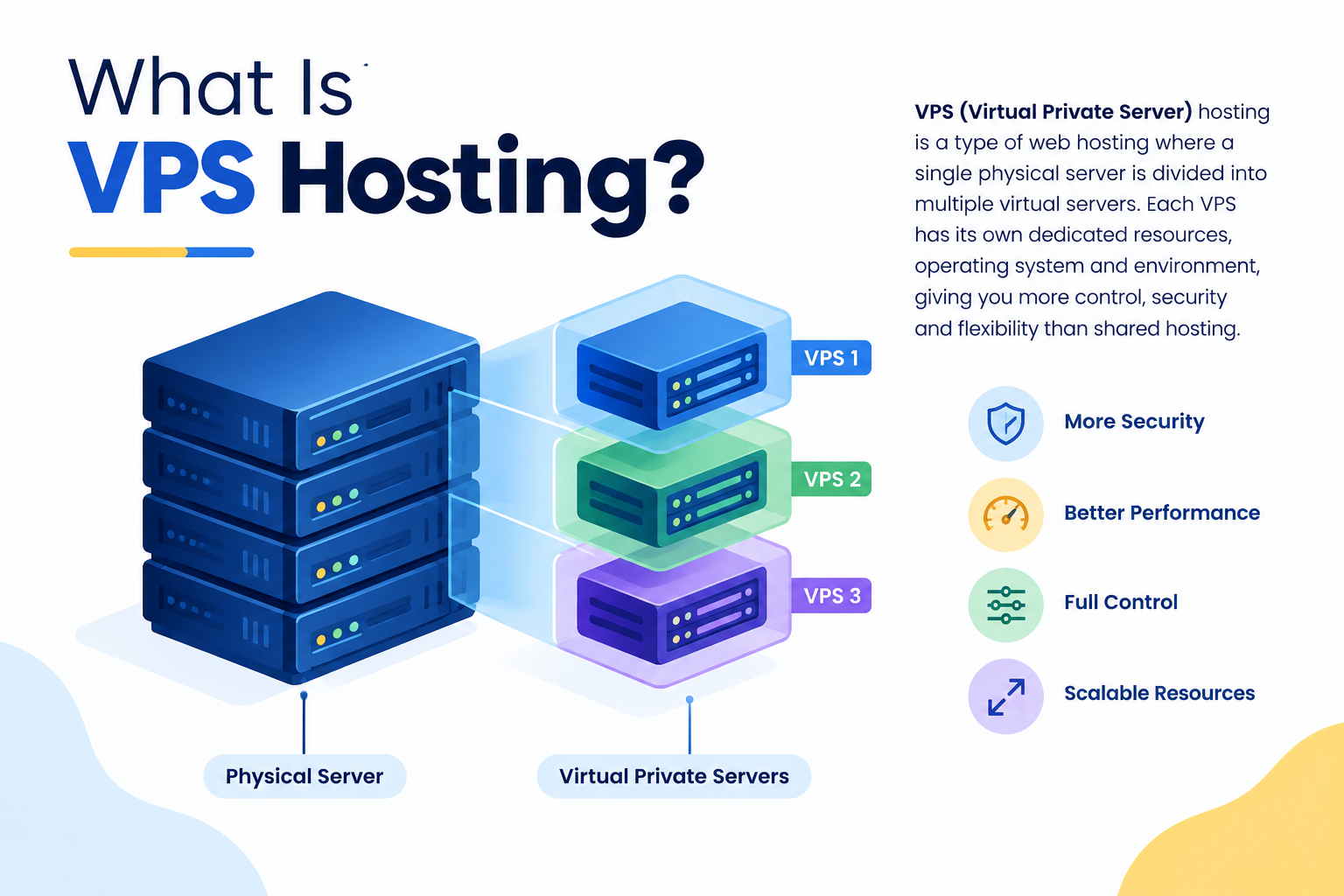
What Is VPS Hosting?
VPS stands for Virtual Private Server. A physical server is divided into separate virtual environments, and each VPS receives its own allocated resources and operating system environment.
Think of it like an office building. Shared hosting is similar to several small businesses working from the same open workspace. A VPS is closer to having your own office suite: the building is still shared, but your resources and environment are separated from other users.
With VPS hosting, a law firm can typically get:
- Dedicated CPU and RAM resources
- SSD or NVMe storage
- Root or administrator access
- Linux or Windows operating system options
- Custom software installation
- Independent security configuration
- Scalable resources as requirements grow
Why Law Firms May Outgrow Shared Hosting
Shared hosting is designed to keep website management simple and affordable. It is often a good fit for brochure websites, small blogs and basic company sites.
A legal practice may need more when its digital workload becomes larger or more specialized. For example, the firm may run a document portal, a private database, a case-management application or several websites from the same infrastructure.
A VPS gives the firm more predictable resources and more control over how the server is configured. That does not automatically make every application secure, but it provides a stronger foundation for an IT team or managed hosting provider to build on.
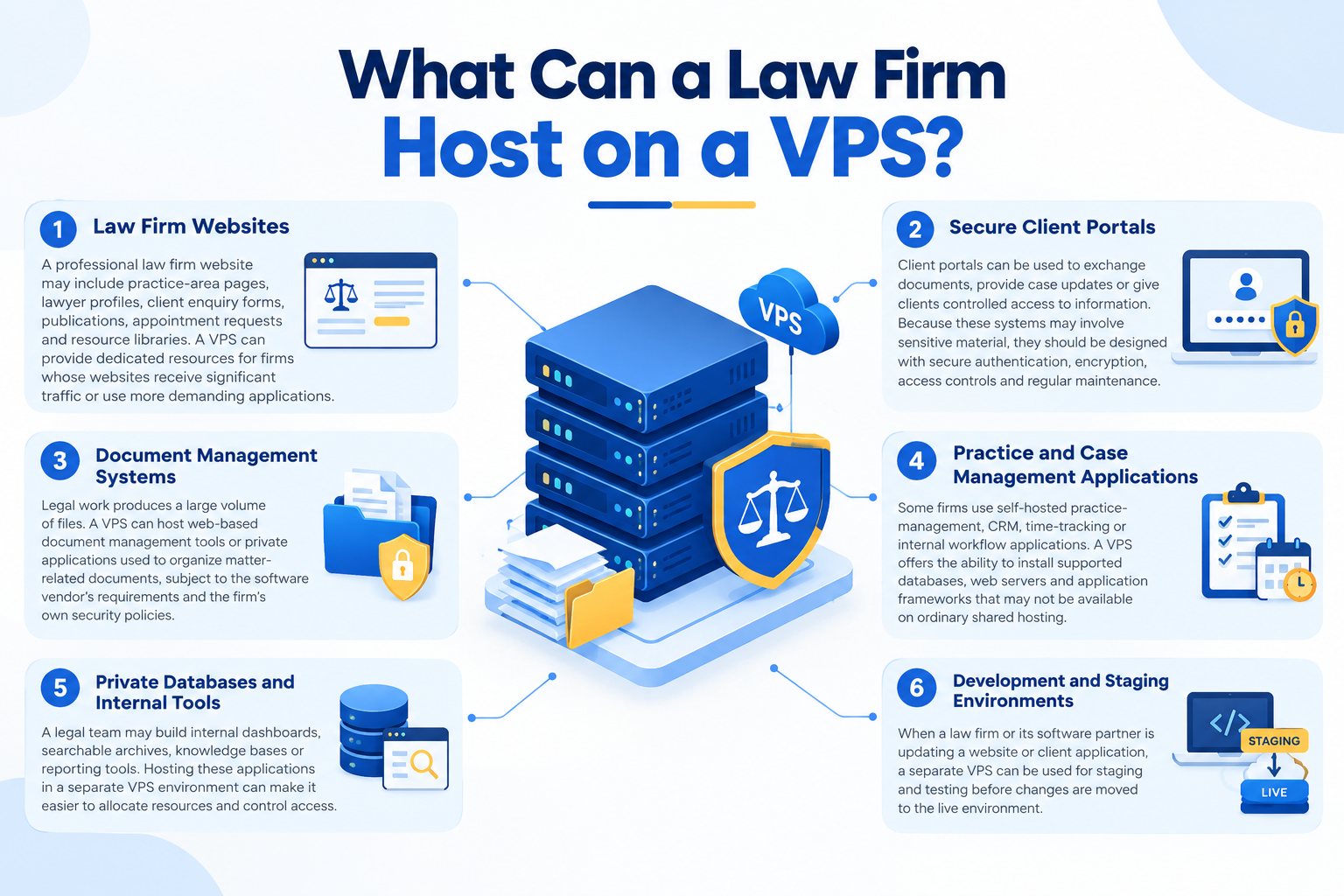
What Can a Law Firm Host on a VPS?
1. Law Firm Websites
A professional law firm website may include practice-area pages, lawyer profiles, client enquiry forms, publications, appointment requests and resource libraries. A VPS can provide dedicated resources for firms whose websites receive significant traffic or use more demanding applications.
2. Secure Client Portals
Client portals can be used to exchange documents, provide case updates or give clients controlled access to information. Because these systems may involve sensitive material, they should be designed with secure authentication, encryption, access controls and regular maintenance.
3. Document Management Systems
Legal work produces a large volume of files. A VPS can host web-based document management tools or private applications used to organize matter-related documents, subject to the software vendor’s requirements and the firm’s own security policies.
4. Practice and Case Management Applications
Some firms use self-hosted practice-management, CRM, time-tracking or internal workflow applications. A VPS offers the ability to install supported databases, web servers and application frameworks that may not be available on ordinary shared hosting.
5. Private Databases and Internal Tools
A legal team may build internal dashboards, searchable archives, knowledge bases or reporting tools. Hosting these applications in a separate VPS environment can make it easier to allocate resources and control access.
6. Development and Staging Environments
When a law firm or its software partner is updating a website or client application, a separate VPS can be used for staging and testing before changes are moved to the live environment.
Security Is a Major Consideration for Legal Hosting
Law firms routinely handle confidential and commercially sensitive information. Server hosting therefore needs to be treated as part of a wider security strategy rather than as a standalone solution.
A VPS gives administrators control over security settings such as:
- Firewalls and network access rules
- SSH or Remote Desktop access
- User accounts and permissions
- Operating system and software updates
- Malware protection and monitoring
- TLS/SSL configuration
- Backup schedules and retention
- Logging and administrative access
The important point is that a VPS provides control, but that control must be used correctly. An unmanaged server that is not patched or monitored can create unnecessary risk. Firms without experienced server administrators should strongly consider a managed VPS or professional system administration.
Managed VPS vs Unmanaged VPS for Law Firms
Area | Managed VPS | Unmanaged VPS |
|---|---|---|
Server setup | Hosting team assists with setup and configuration | Firm or IT partner handles configuration |
Updates | Provider can manage system updates | Firm manages updates |
Monitoring | Usually included or available | Must be configured internally |
Technical skill | Lower day-to-day server expertise required | Requires experienced administration |
Best fit | Firms that want support with server operations | Firms with a capable internal IT or DevOps team |
For many legal practices, managed VPS hosting is the more practical option because lawyers and support staff can focus on legal work while server maintenance is handled by specialists.
VPS vs Shared Hosting vs Dedicated Server
Feature | Shared Hosting | VPS | Dedicated Server |
|---|---|---|---|
Resource isolation | Limited | Strong | Complete physical server |
Administrative control | Limited | High | Very high |
Custom software | Limited | Yes | Yes |
Typical cost | Lowest | Mid-range | Highest |
Scalability | Plan-based | Flexible | Powerful but hardware-dependent |
Suitable for | Basic firm websites | Portals, apps, databases, larger sites | Heavy workloads or strict infrastructure needs |
A VPS sits in the middle: more control and dedicated resources than shared hosting, without the cost of renting an entire physical machine.
Remote Work and Multi-Office Legal Teams
Law firms often work across offices, courts, client locations and home environments. A VPS can support centrally hosted applications that authorized staff access remotely, provided the application is designed for that use and secure remote access is configured properly.
For example, a Windows VPS may be used for certain Windows-based applications or Remote Desktop workflows, while a Linux VPS may be better suited to web applications, WordPress, PHP, Laravel, Python or database-backed services.
The right operating system should be chosen according to the software the firm actually uses, not simply by preference.
Backups Should Be Part of the Plan
A backup is especially important for systems containing case files, website data or application databases. Accidental deletion, software errors, failed updates and cyber incidents can all affect availability.
A sensible VPS backup approach can include:
- Automated scheduled backups
- Multiple restore points
- A copy stored separately from the main VPS where appropriate
- Database backups for dynamic applications
- Periodic restore testing
- A clear retention policy
The key is not simply creating backups. The firm should know how quickly important systems can be restored and who is responsible for recovery.
Performance During Busy Periods
Legal websites can experience traffic spikes when a major case, corporate announcement or public-interest matter attracts attention. Client portals and internal systems can also become busier when teams are working against filing deadlines.
Because a VPS provides allocated resources, the firm has a clearer performance baseline than on a heavily shared environment. If requirements increase, RAM, CPU, storage or the overall VPS plan can be upgraded, depending on the hosting platform.
Pakistan VPS Hosting for Local Law Firms
For law firms serving clients mainly in Pakistan, server location can matter. A Pakistan-based VPS can reduce network latency for local users, while international locations may be better for firms whose clients or teams are primarily overseas.
CreativeON offers VPS hosting in Pakistan as well as international server locations, with Linux and Windows options, root access and managed server services. The right location and configuration should be based on the firm’s users, applications and security requirements rather than choosing a server only by price.
What to Look for in VPS Hosting for a Law Firm
When comparing VPS providers, legal practices should look beyond headline specifications. Important factors include:
- Guaranteed CPU and RAM
- SSD or NVMe storage
- Reliable uptime
- Managed server support
- Backup options
- DDoS and firewall protection
- Linux and Windows choices
- Root or administrator access when required
- Clear upgrade paths
- Responsive technical support
- Server locations suitable for the firm’s users
It is also important to check the requirements of any legal software, document-management platform or client portal before moving it to a new server.
A Simple Example
Consider a growing law firm with a public website, a client portal and an internal case-tracking application. Keeping everything on one small shared hosting plan may eventually create limitations.
A more structured setup could be:
- VPS 1: Public website and marketing content
- VPS 2: Client portal and database
- VPS 3: Internal application or staging environment
Not every firm needs several servers, but separating workloads can make resource planning, maintenance and access control easier as systems become more important.
Why CreativeON VPS Hosting Can Fit Legal Practices
CreativeON has been providing hosting services to Pakistani businesses for more than two decades. Its VPS offering includes dedicated virtual resources, Linux and Windows options, root access, multiple server locations and managed support for organizations that do not want to maintain the server themselves.
For a law firm, the goal should be to choose the smallest reliable configuration that comfortably supports the website or application today, while leaving a clear path to scale as the practice grows.
Final Thoughts
A VPS for law firms can provide a useful balance of performance, control, flexibility and cost. It is particularly relevant when a legal practice has moved beyond a basic website and now depends on client portals, databases, custom applications or other digital services.
The server itself is only one part of the solution. Strong access controls, regular updates, backups, secure application design and responsible administration remain essential.
For law firms in Pakistan that need more control than shared hosting can provide, a properly managed VPS can offer a practical foundation for reliable digital operations without immediately moving to a full dedicated server.
Frequently Asked Questions
