

When your website or application starts serving users from different countries or regions, relying on a single VPS server may no longer provide the best experience. Visitors who are far from your server can experience higher latency, slower page loads, and less responsive applications.
A multi-region VPS deployment strategy helps address this challenge by placing VPS servers in multiple geographic locations. Instead of serving every visitor from one data center, you can position your infrastructure closer to your users, improving responsiveness while preparing your business for future growth.
This guide focuses on the planning side of a multi-region VPS deployment strategy. It explains when deploying VPS servers across different regions makes sense, what factors to consider before expanding, and how to build a practical deployment plan. Detailed topics such as load balancing, high availability, disaster recovery, and monitoring are separate subjects that should be planned alongside your deployment strategy rather than as part of it.
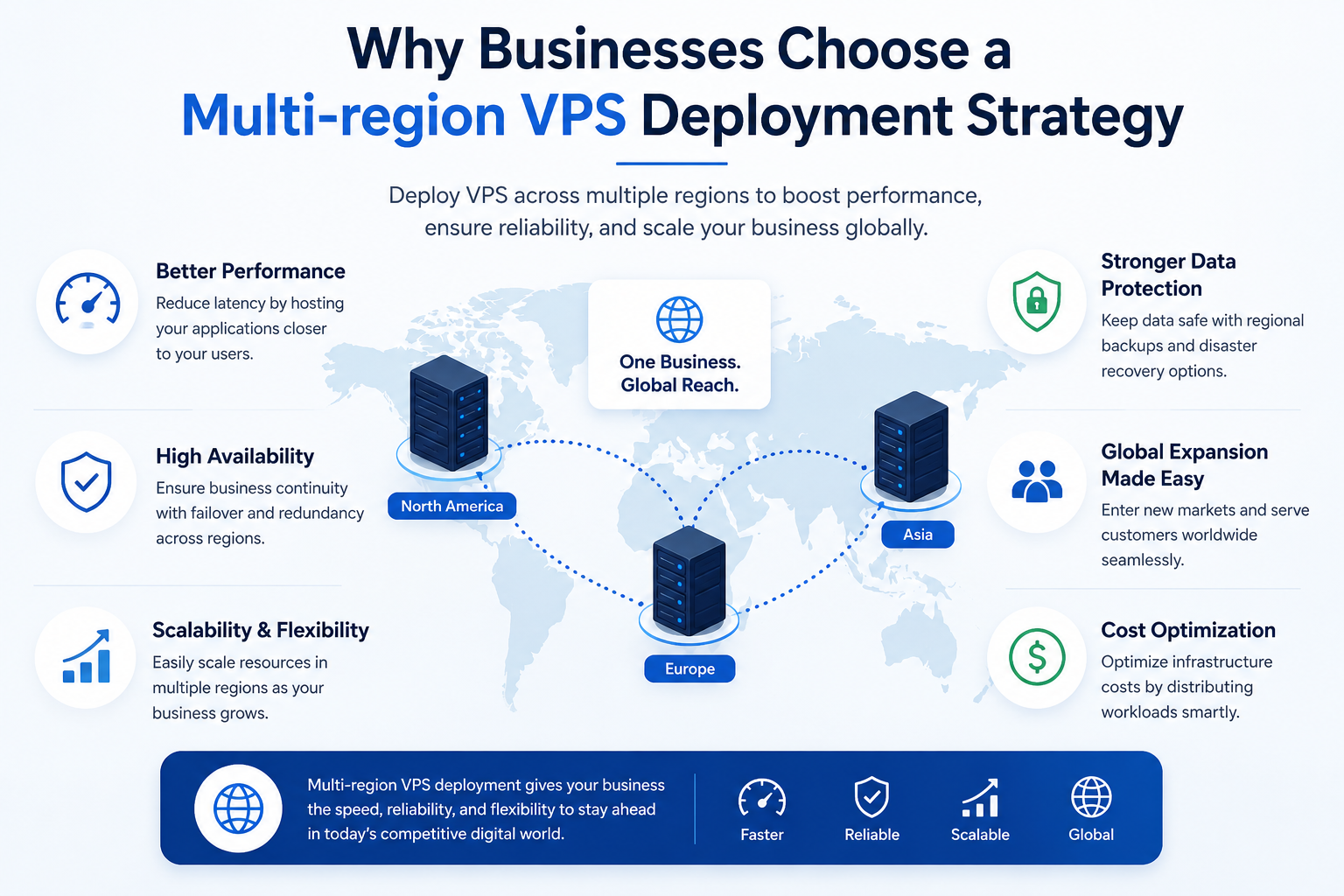
Why Businesses Choose a Multi-region VPS Deployment Strategy
As businesses expand into new markets, the physical distance between users and servers becomes increasingly important. Every request travels across networks, and longer distances often result in increased latency.
By deploying VPS servers in strategically selected regions, businesses can build an infrastructure that better supports an international audience.
Some of the key benefits include:
- Improved response times for users in different regions.
- Better support for international customers and remote teams.
- A scalable infrastructure for business expansion.
- Greater flexibility when serving geographically distributed users.
- A stronger foundation for regional service continuity when combined with appropriate routing and failover solutions.
The goal is not to deploy servers everywhere, but to place infrastructure where it delivers the greatest value to your users.
When Does a Multi-region VPS Deployment Make Sense?
A multi-region deployment is not necessary for every business. If most of your visitors are located within the same country or region, a well-configured VPS in a nearby data center is often sufficient.
However, a multi-region VPS deployment becomes more beneficial when:
- Your customers are located in multiple countries.
- You operate a SaaS platform with international users.
- Your applications serve remote teams across different regions.
- You are expanding your business into new global markets.
- Your APIs or web services receive traffic from multiple continents.
Many organizations begin with one primary deployment region and add a second region only after user growth justifies the additional infrastructure. This phased approach keeps costs under control while making future expansion easier.
Planning Your VPS Deployment Regions
Choosing where to deploy your VPS servers is one of the most important decisions in a multi-region VPS deployment strategy. Rather than selecting locations based solely on availability, your decisions should be guided by where your users are located and where your business plans to grow.
When evaluating deployment regions, consider factors such as:
- The geographic distribution of your users.
- Network latency between users and your servers.
- Available VPS data center locations.
- Regional regulations or data residency requirements.
- Future business expansion plans.
For example, a company serving customers across the Middle East, Europe, and Asia may benefit more from deploying VPS servers in strategically located regional data centers than relying on a single server to handle all traffic.
The objective is to balance user proximity with operational simplicity, rather than deploying more servers than your business actually needs.
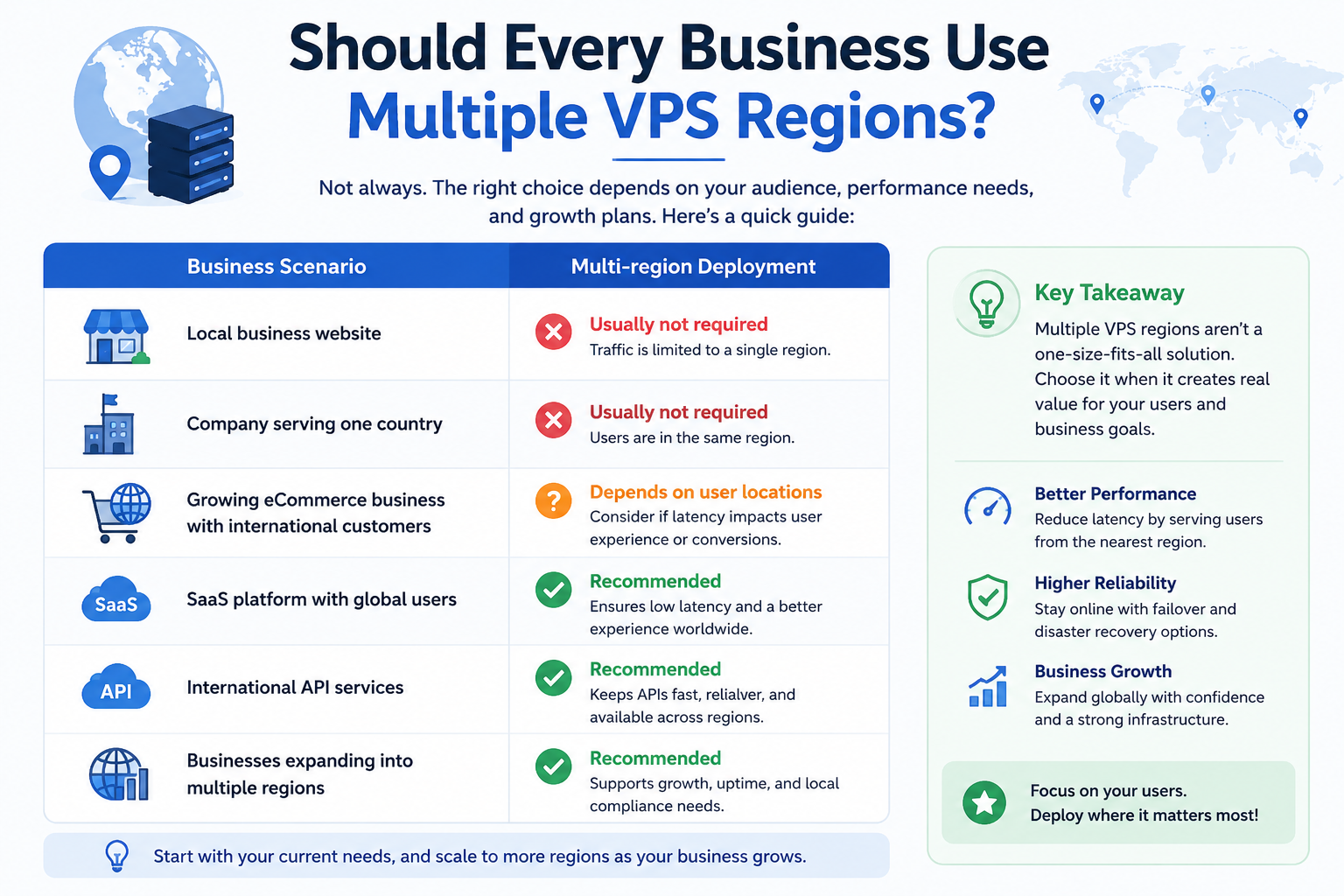
Should Every Business Use Multiple VPS Regions?
The answer is no.
While multi-region deployments offer clear advantages for some organizations, they also introduce additional infrastructure, management, and operational costs. Expanding too early can make your environment more complex without providing meaningful benefits.
The table below provides a general guideline.
Business Scenario | Multi-region Deployment |
Local business website | Usually not required |
Company serving one country | Usually not required |
Growing eCommerce business with international customers | Depends on user locations |
SaaS platform with global users | Recommended |
International API services | Recommended |
Businesses expanding into multiple regions | Recommended |
The decision should always be based on your users’ geographic distribution and business objectives, rather than the assumption that more VPS servers automatically result in better performance.
Internal Linking Opportunities
To continue building your VPS knowledge, consider linking this article to related topics such as:
- Choosing the Right VPS Server Location
- Vertical VPS Scaling
- Horizontal VPS Scaling
- VPS Load Balancing
- High Availability VPS Architecture
These subjects complement a multi-region deployment strategy but address different aspects of VPS infrastructure, helping maintain a clear topical structure for your knowledge base.
Organizing Services Across Multiple Regions
A successful multi-region VPS deployment strategy is about more than placing servers in different countries. It also involves deciding how your services will be distributed across those regions.
Not every application or service needs to run on every VPS. Some businesses deploy the same application in multiple regions to serve local users, while others dedicate certain regions to specific workloads. The right approach depends on your application’s architecture and business requirements.
When planning your deployment, consider:
- Which services should be available in every region.
- Which workloads can remain centralized.
- How future expansion may affect your infrastructure.
- Whether your deployment plan can grow without major redesigns.
Keeping your deployment organized from the beginning makes it easier to manage as your business expands.
Planning How Users Reach the Right Region
Once you have VPS servers in multiple locations, users need to be directed to the most appropriate server. This is typically handled through DNS-based traffic management or other routing technologies, which are planned separately from the deployment strategy itself.
Your planning should focus on questions such as:
- Which regions will serve which customers?
- How will new regions be introduced as your business grows?
- What happens if a regional server becomes temporarily unavailable?
- How can users experience consistent service across locations?
Thinking through these scenarios early helps create a more scalable infrastructure without diving into implementation details.
Consider Data Consistency Early
If your application operates in more than one region, you’ll also need to consider how important data is managed across your VPS servers.
There isn’t a single approach that works for every business. Some applications keep data synchronized across regions, while others intentionally store certain information locally based on operational or regulatory requirements.
Before expanding, think about:
- Which information must remain consistent across all regions.
- Which data can stay local to a specific region.
- How frequently shared information needs to be updated.
- Whether your application architecture supports regional deployments.
Answering these questions during the planning stage can help prevent unnecessary complexity later.
Avoid Expanding Too Quickly
One of the most common mistakes is deploying VPS servers in many regions before there is a genuine business need.
While additional locations can improve user proximity, they also increase:
- Infrastructure costs.
- Deployment coordination.
- System administration tasks.
- Software update management.
- Operational complexity.
For many businesses, starting with one primary region and one secondary region provides the right balance between performance and manageability. Additional regions can be added gradually as customer demand grows.
Best Practices for a Multi-region VPS Deployment Strategy
A well-planned deployment focuses on long-term scalability rather than the number of servers you operate.
Some practical recommendations include:
- Expand based on actual user demand, not assumptions.
- Keep operating systems and software versions consistent across regions.
- Standardize deployment procedures for easier management.
- Document your regional infrastructure clearly.
- Review user traffic regularly to identify future deployment opportunities.
- Plan for future growth without making the initial deployment unnecessarily complex.
These practices help create a more predictable and maintainable VPS infrastructure as your business continues to expand.
Internal Linking Opportunities
For readers who want to explore related VPS topics, consider linking to:
- Choosing the Right VPS Server Location
- VPS Load Balancing
- High Availability VPS Architecture
- Disaster Recovery for VPS
- VPS Monitoring Best Practices
Each of these topics supports a multi-region deployment strategy while covering a different aspect of VPS infrastructure, helping readers build a more complete understanding without overlapping content.
How CreativeON Can Help
Planning a multi-region VPS deployment strategy involves more than simply launching servers in different locations. It requires careful consideration of your users, application requirements, future growth plans, and overall infrastructure design.
At CreativeON, we provide reliable VPS hosting solutions that help businesses build scalable and flexible hosting environments. Whether you’re expanding into new markets or planning your first regional deployment, our team can help you choose VPS resources that align with your business goals without adding unnecessary complexity.
Our objective is to help you build infrastructure that is ready to grow as your business grows.
Frequently Asked Questions
