
Server memory does more than help applications run smoothly. It also plays an important role in keeping data accurate while a server processes information. A memory error, even a small one, can affect the data being handled by an application or operating system.
This is one reason many enterprise servers use ECC RAM (Error-Correcting Code memory). Unlike standard non-ECC memory, ECC RAM can detect and correct certain memory errors automatically. This additional protection helps improve memory reliability in systems that handle databases, virtualization, business applications, and other important workloads.
But what exactly does ECC RAM do? Is it necessary for every server, and how is it different from regular RAM?
Let’s look at how ECC memory works, where it matters, and what to check before choosing it for a server.
What Is ECC RAM in Servers?
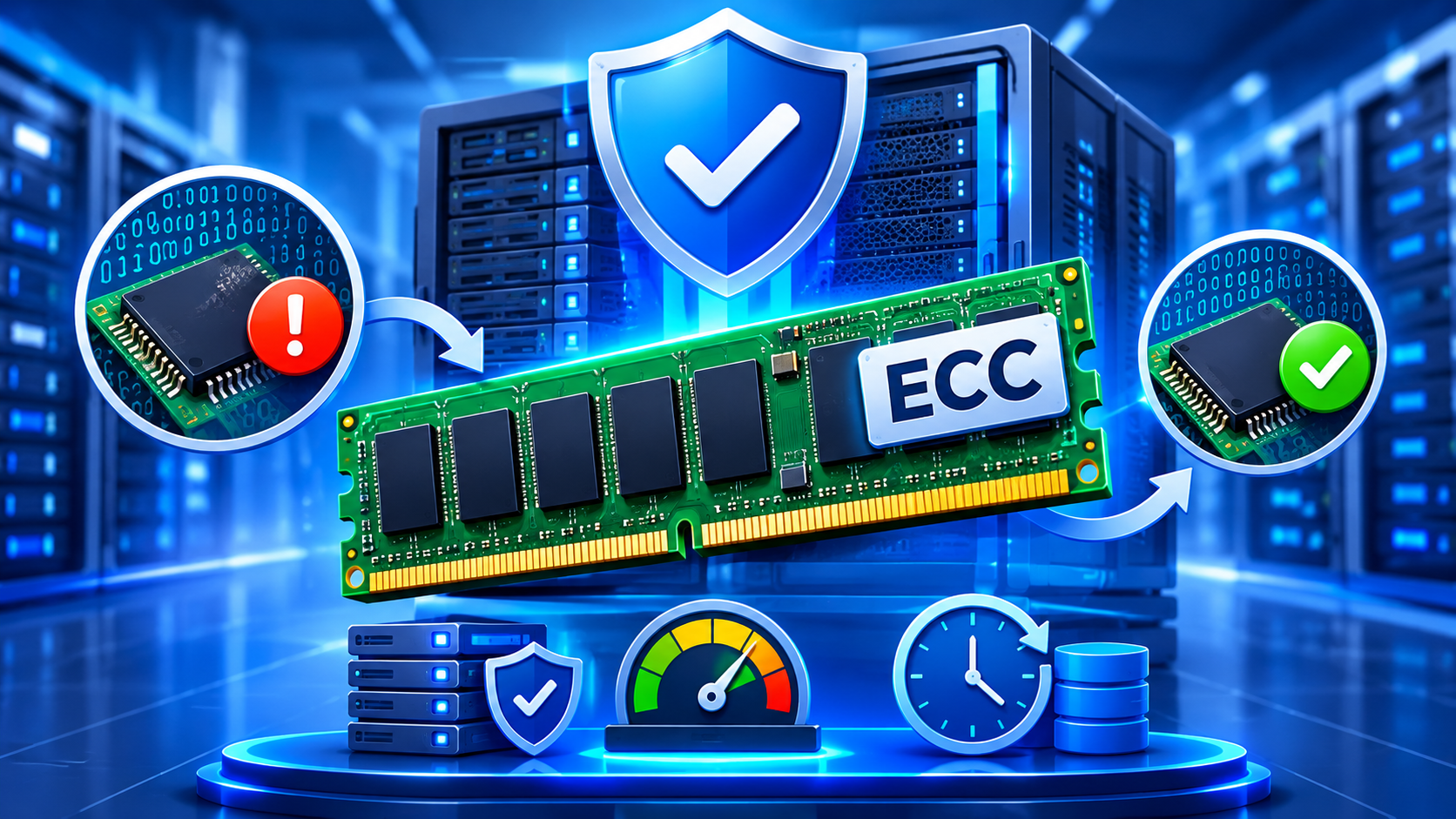
ECC RAM stands for Error-Correcting Code Random Access Memory. It is a type of computer memory designed to detect and correct certain data errors that occur while information is stored in or read from memory.
During normal operation, a server constantly moves data between its processor and RAM. Occasionally, an electrical disturbance or hardware-related issue can cause a bit to change unexpectedly. This is commonly known as a memory error or bit flip.
For example, a binary value stored as 10110010 might unexpectedly change to 10110011. Even a single changed bit can affect the information being processed.
ECC memory uses additional error-checking information to identify certain changes and correct errors within its supported limits.
This is particularly useful in servers that operate continuously and handle important business information.
How Does ECC RAM Work?
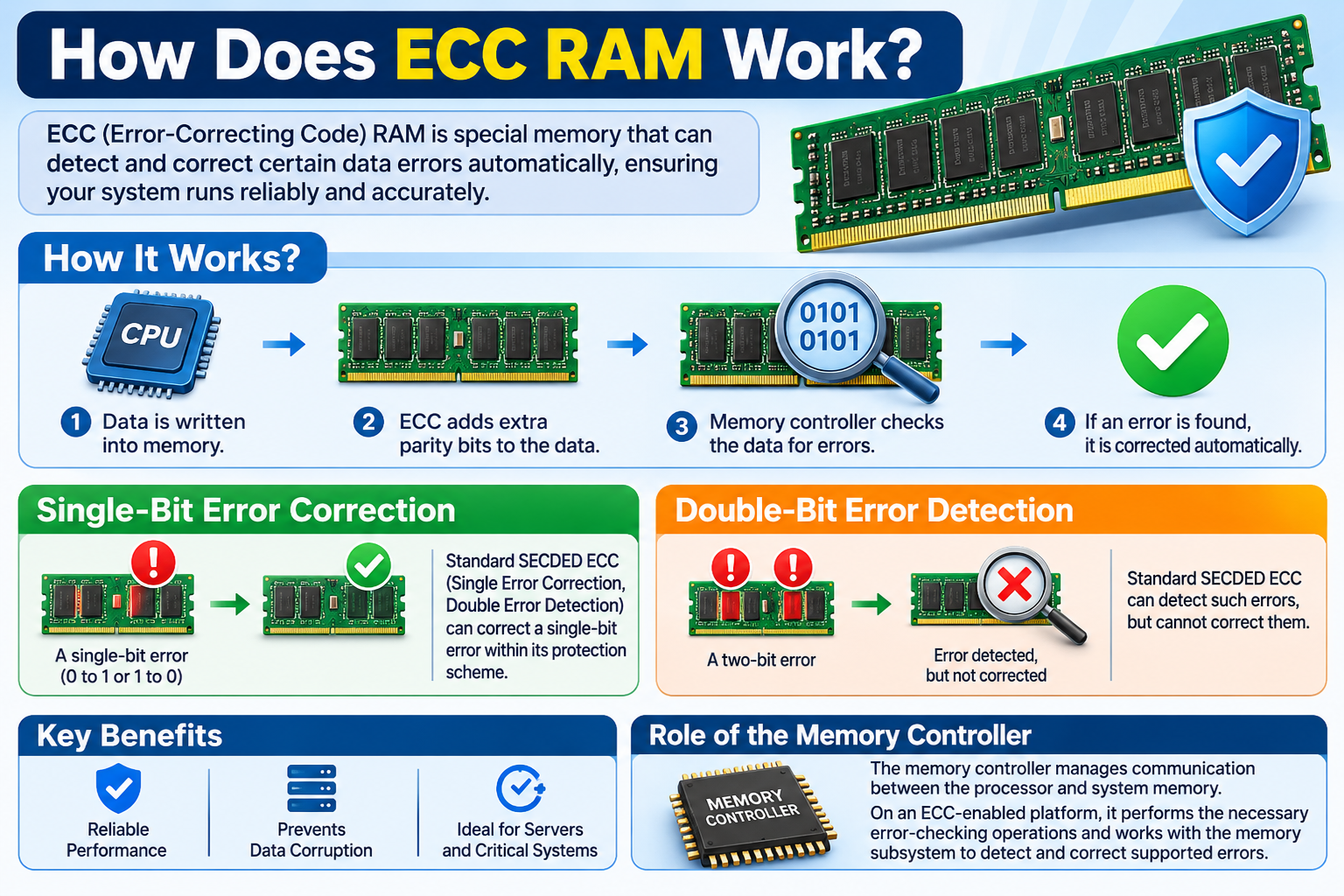
ECC memory works by storing additional error-checking bits alongside the actual data. The memory controller uses this information to check whether the data has changed unexpectedly.
When the processor requests information from RAM, the memory controller checks the data against its corresponding error-correction information.
Depending on the ECC implementation, the system can detect and correct certain errors automatically.
Single-Bit Error Correction
A single-bit error occurs when one bit changes from 0 to 1 or from 1 to 0.
Standard SECDED ECC (Single Error Correction, Double Error Detection) can correct a single-bit error within its defined protection scheme.
For example, if a memory error changes one bit in a stored value, the memory controller can identify the error and reconstruct the correct data before passing it to the processor.
Double-Bit Error Detection
A double-bit error occurs when two bits in the protected data unit change unexpectedly.
Standard SECDED ECC can detect such an error but generally cannot correct it.
More advanced server memory protection technologies may handle additional error patterns or certain DRAM device failures, depending on the processor and server platform.
The important point is that ECC improves memory error handling, but its correction capabilities depend on the implementation.
Role of the Memory Controller
The memory controller manages communication between the processor and system memory.
On an ECC-enabled platform, it performs the necessary error-checking operations and works with the memory subsystem to detect and correct supported errors.
If an error cannot be corrected, the system may report it through firmware, hardware management tools, or operating system error-reporting facilities.
Why Is ECC Memory Important in Servers?
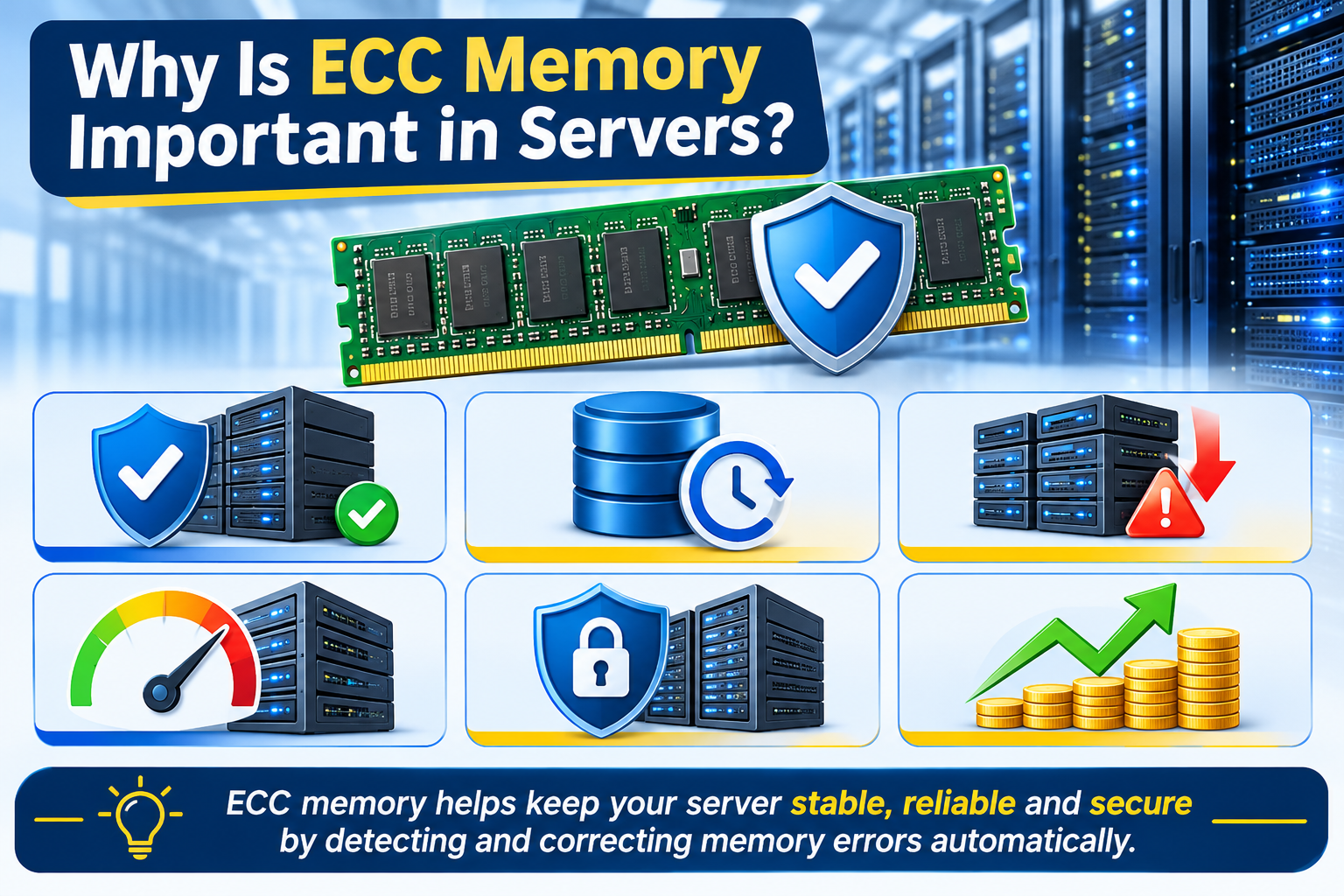
Memory errors can affect server stability and the accuracy of information being processed. ECC RAM adds another layer of protection against these errors.
Its importance becomes clearer when looking at common server workloads.
1. Protecting Data Integrity
Servers frequently process information that businesses depend on, including customer records, database transactions, financial information, and application data.
An undetected memory error can potentially affect data being processed.
ECC memory helps reduce this risk by correcting supported errors before they affect the information delivered to the processor.
2. Improving Server Stability
Servers often operate for extended periods without interruption. A memory-related error can sometimes cause application failures, system instability, or unexpected crashes.
By correcting supported memory errors, ECC can help reduce certain memory-related problems.
However, ECC does not guarantee uninterrupted server operation.
3. Supporting Virtualization Environments
Virtualization servers run multiple virtual machines on a single physical server.
Each virtual machine uses a portion of the available system memory. This makes memory reliability particularly important in environments hosting multiple applications and services.
ECC memory provides additional protection against supported memory errors across the physical server’s workloads.
4. Supporting Database Servers
Database servers continuously process, store, and retrieve information.
For businesses operating customer management systems, ecommerce platforms, financial applications, or other database-driven services, data integrity is an important consideration.
ECC memory adds protection against certain memory errors while database operations are running.
5. Supporting Business-Critical Applications
Enterprise applications, business management systems, and other important services often depend on reliable server infrastructure.
ECC memory is one component that helps improve hardware reliability, particularly when combined with appropriate monitoring, storage protection, and backup practices.
ECC RAM vs Non-ECC RAM: What’s the Difference?
The main difference between ECC and non-ECC RAM is their ability to detect and correct memory errors.
Standard non-ECC RAM does not provide the same system-level ECC error protection.
Here is a comparison:
| Feature | ECC RAM | Non-ECC RAM |
| Error detection | Yes | No system-level ECC |
| Single-bit correction | Supported by standard SECDED implementations | No |
| Double-bit detection | Supported by standard SECDED implementations | No |
| Additional error-checking information | Yes | No |
| Memory reliability | Additional protection against certain errors | No equivalent ECC protection |
| Typical applications | Servers and professional workstations | Consumer desktops and general-purpose systems |
| Platform requirements | Requires compatible ECC support | Generally supported by consumer platforms |
ECC RAM is particularly valuable when system reliability and data integrity are important.
However, non-ECC memory is not automatically unsuitable for every server. The right choice depends on the hardware platform, workload, and level of reliability required.
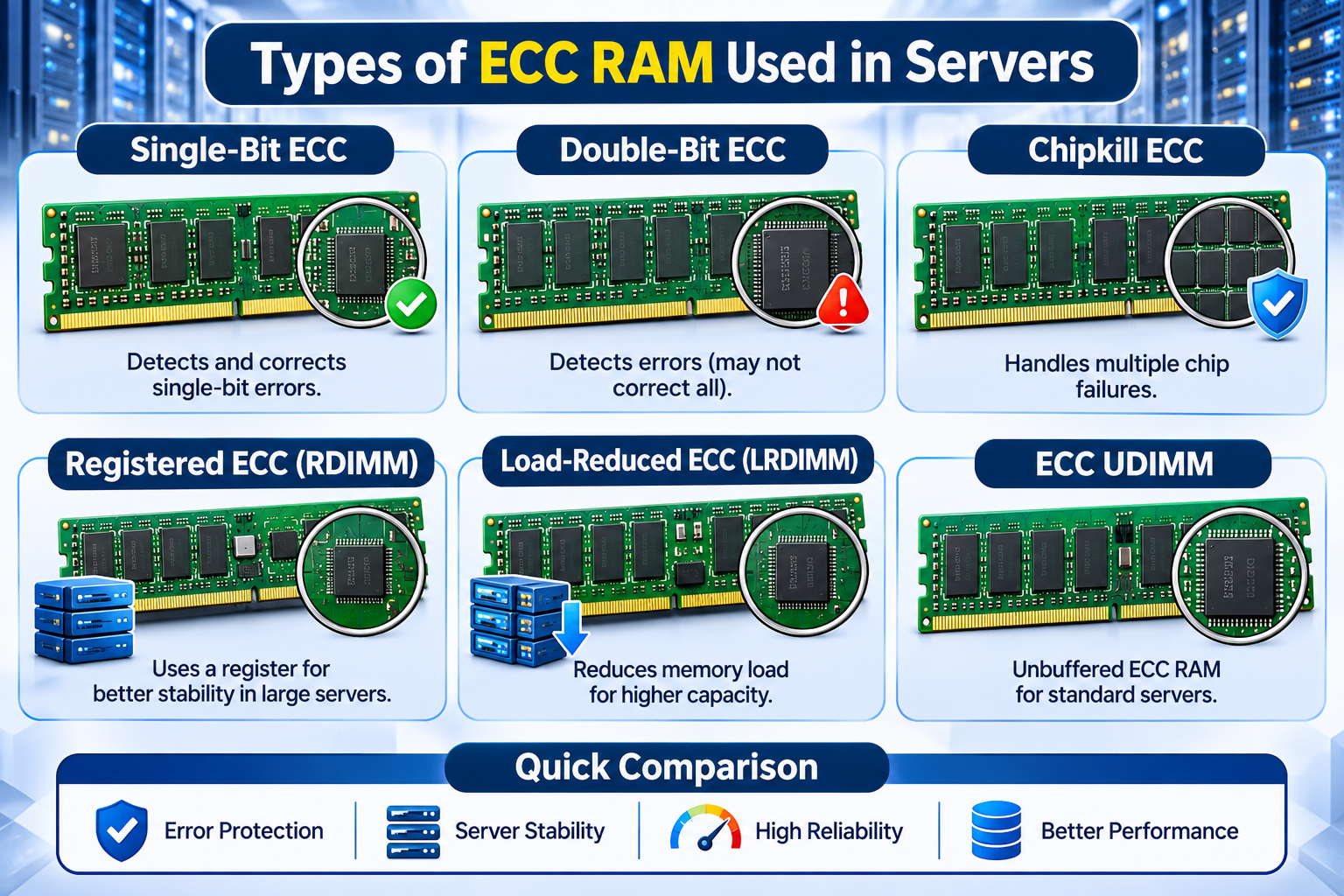
Types of ECC RAM Used in Servers
ECC describes the error-detection and correction capability of memory. Registered and unbuffered describe different memory module designs.
Understanding this distinction is important when selecting server memory.
1. ECC UDIMM (Unbuffered ECC Memory)
ECC UDIMM provides error correction without using a register between the memory controller and the DRAM chips.
It is commonly found in supported entry-level servers and professional workstations.
Typical characteristics include:
- ECC error correction support.
- Unbuffered memory architecture.
- Generally used in lower-capacity server configurations.
- Requires processor and motherboard compatibility.
2. ECC RDIMM (Registered ECC Memory)
Registered DIMMs use a register to buffer address and command signals between the memory controller and memory chips.
This reduces the electrical load on the memory controller and helps server platforms support larger memory configurations.
Common applications include:
- Enterprise servers.
- Virtualization hosts.
- Database infrastructure.
- Business-critical workloads.
RDIMM is widely used in enterprise server platforms, but it must be supported by the processor and motherboard.
3. ECC LRDIMM (Load-Reduced Memory)
Load-Reduced DIMMs use additional buffering to reduce the electrical load associated with memory devices.
They are designed for compatible server platforms that require high memory capacity and density.
LRDIMMs are particularly useful in certain high-capacity enterprise configurations.
Important: ECC UDIMM, RDIMM, and LRDIMM are not interchangeable. A server must support the specific memory type being installed, and different module types generally cannot be mixed in the same memory configuration.
Is DDR5 On-Die ECC the Same as Server ECC RAM?
No. This is an important distinction when choosing modern server memory.
DDR5 memory includes a feature called On-Die ECC. It provides error correction within individual DRAM chips to help manage certain internal memory errors.
However, On-Die ECC is not the same as system-level ECC memory.
The difference is:
- On-Die ECC: Corrects certain errors within an individual DRAM chip.
- System-level ECC: Provides additional error detection and correction across the memory subsystem, working with the processor’s memory controller.
On-Die ECC does not automatically provide the same protection as a complete system-level ECC implementation.
Therefore, when purchasing DDR5 memory for a server, check whether the processor, motherboard, and memory configuration support system-level ECC.
When Does ECC RAM Matter Most?
ECC RAM is especially valuable in environments where memory reliability is an important operational requirement.
Consider it for the following workloads.
| Server workload | Why ECC matters |
| Database servers | Helps protect data being processed against certain memory errors |
| Virtualization servers | Adds protection in systems running multiple virtual machines |
| Enterprise applications | Supports reliable operation of important business software |
| Financial systems | Provides an additional layer of memory error protection |
| Hosting infrastructure | Helps improve memory reliability across server workloads |
| Long-running workloads | Helps manage certain memory errors during continuous operation |
For a business hosting important applications or databases, ECC memory is generally a sensible hardware consideration.
However, the exact requirement depends on the server platform and workload.
How to Check Whether Your Server Supports ECC RAM
Not every processor and motherboard supports ECC memory. Even if an ECC module physically fits into a memory slot, that does not guarantee that error correction will operate.
Before purchasing or upgrading server memory, check the following:
- Processor support: Confirm that the processor’s memory controller supports the required ECC functionality.
- Motherboard compatibility: Check whether the motherboard supports ECC memory.
- Memory generation: Verify whether the platform requires DDR4 or DDR5 memory.
- DIMM type: Identify whether the server supports ECC UDIMM, RDIMM, or LRDIMM.
- Memory capacity: Check the maximum supported capacity and module configurations.
- BIOS/UEFI: Verify that the firmware supports the required memory configuration and that ECC functionality is enabled.
- Operating system reporting: Confirm whether the hardware and operating system can report corrected and uncorrected memory errors.
For branded servers, consult the manufacturer’s supported memory configuration guide rather than relying only on the memory module’s specifications.
How Can You Monitor ECC Memory Errors?
Installing ECC RAM is only part of maintaining reliable server memory. Monitoring reported memory errors can also help identify potentially failing hardware.
Many server platforms provide hardware management interfaces or firmware logs that report memory-related events.
On supported Linux systems, the EDAC (Error Detection and Correction) subsystem can report hardware memory errors.
Two important error categories are:
- Corrected errors: Errors that the ECC system successfully corrected.
- Uncorrected errors: Errors that the ECC system could not correct.
Repeated corrected errors should not automatically be ignored. They may indicate a developing memory problem and justify further investigation.
If a server reports repeated or increasing memory errors, check its hardware logs and follow the manufacturer’s diagnostic recommendations. Affected memory modules may need testing or replacement.
What ECC RAM Cannot Protect Against
ECC memory improves protection against certain hardware memory errors, but it is not a complete data protection solution.
It does not independently prevent:
- Hard disk or SSD failures.
- Software bugs and application errors.
- Malware and ransomware attacks.
- Power supply failures.
- Network transmission problems.
- Every type of multi-bit memory error.
- Data corruption caused by incorrect application logic.
Businesses should combine ECC memory with other reliability measures, including regular backups, appropriate storage redundancy, hardware monitoring, and disaster recovery planning.
For example, ECC may correct a supported memory error, but it cannot restore a database that has been deleted or damaged by a software problem.
Frequently Asked Questions About ECC RAM
