
Choosing between dedicated server rental and buying your own server hardware is an important infrastructure decision. Both options provide access to dedicated computing resources, but they differ in upfront investment, ongoing costs, hardware ownership, maintenance responsibilities, and long-term flexibility.
Renting a dedicated server allows businesses to use physical server hardware in a professional data centre without purchasing the equipment. Buying hardware provides ownership and greater control, but also introduces additional responsibilities for maintenance, power, cooling, and infrastructure management.
There is also a third option: purchasing your own server and placing it in a third-party data centre through colocation.
Understanding these differences can help you select an infrastructure model that fits your budget, technical capabilities, and business requirements.
In this guide, we compare dedicated server rental vs buying hardware, including their costs, advantages, limitations, and practical use cases.
1. What Is Dedicated Server Rental?
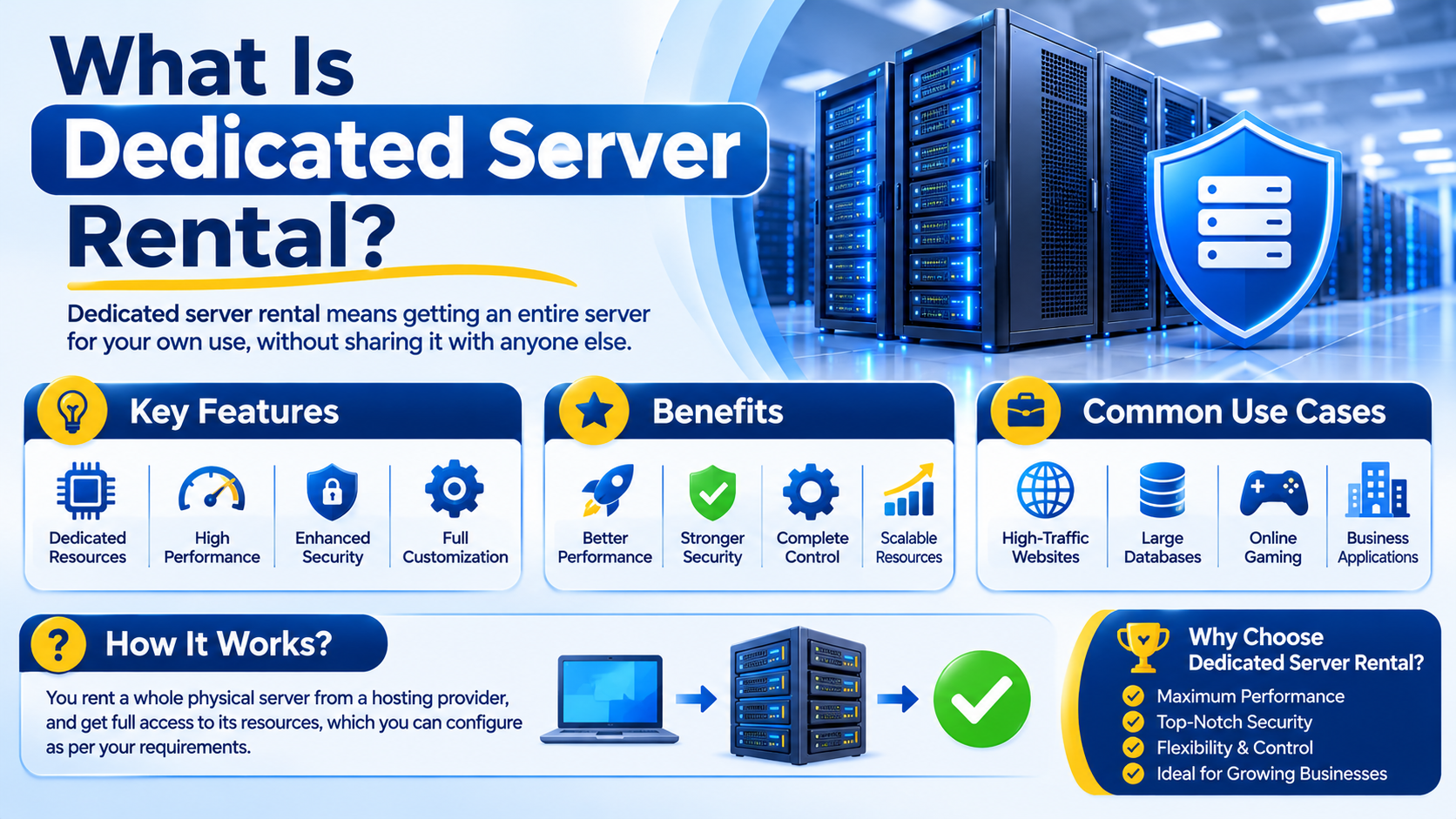
Dedicated server rental means leasing a physical server from a hosting provider or data centre for a recurring monthly or annual fee.
The provider owns the physical equipment and makes its computing resources available exclusively to your business. The server operates within the provider’s data centre, where power, cooling, network connectivity, and physical security are generally provided as part of the service.
Depending on the hosting agreement, the provider may also handle hardware maintenance and replacement.
With dedicated server rental, businesses typically receive:
- Dedicated CPU, RAM, and storage resources.
- A physical server allocated exclusively to their use.
- Data centre power and cooling infrastructure.
- Network connectivity and bandwidth.
- Hardware support according to the service agreement.
- Remote server access and administration capabilities.
Customers generally remain responsible for their operating system, applications, websites, databases, and software security unless they purchase managed server services.
The main advantage: Businesses can access dedicated server infrastructure without making a substantial upfront investment in physical equipment.
2. What Does Buying Your Own Server Hardware Mean?
Buying server hardware means purchasing a physical server for your organization’s own use.
You own the equipment and decide how it is configured, deployed, maintained, upgraded, and eventually replaced.
However, purchasing a server is only one part of establishing server infrastructure. You also need a suitable environment to operate it.
If you operate the server on your own premises, you may need:
- A secure server room or dedicated facility.
- Reliable electricity and backup power.
- Cooling and ventilation systems.
- Business-grade internet connectivity.
- Network equipment and security.
- Physical access controls.
- Technical personnel for hardware maintenance and administration.
Businesses without their own data centre can consider colocation instead. In this arrangement, you purchase and own the server but place it in a third-party data centre.
You pay for rack space, power, cooling, and network connectivity while retaining ownership of the physical equipment.
The main advantage: Hardware ownership provides greater control over equipment selection, configuration, upgrades, and replacement decisions.
3. Dedicated Server Rental vs Buying Hardware: Key Differences
The following comparison highlights the main differences between renting a dedicated server and purchasing your own equipment.
| Factor | Dedicated Server Rental | Buying Your Own Hardware |
| Initial investment | Relatively low | High upfront investment |
| Payment structure | Monthly or annual | Purchase cost plus ongoing expenses |
| Hardware ownership | Hosting provider | Your business |
| Hardware maintenance | Provider, as agreed | Your responsibility |
| Hardware replacement | According to service agreement | Your responsibility |
| Power and cooling | Generally included | Additional expense |
| Network connectivity | Generally included | Must be arranged separately |
| Hardware configuration | Based on provider inventory | Greater configuration flexibility |
| Hardware upgrades | Subject to available options | Under your control |
| Hardware depreciation | Not your asset | Applies to owned equipment |
| Technical support | Depends on service package | Internal or outsourced |
| Physical access | Limited | Greater control |
| Scalability | Generally easier to add or change servers | Requires additional hardware purchases |
The main difference is responsibility.
With dedicated server rental, the provider owns and maintains the physical infrastructure covered by the agreement. With hardware ownership, your business assumes responsibility for the equipment and its lifecycle.
4. Cost Comparison: Renting vs Buying a Dedicated Server
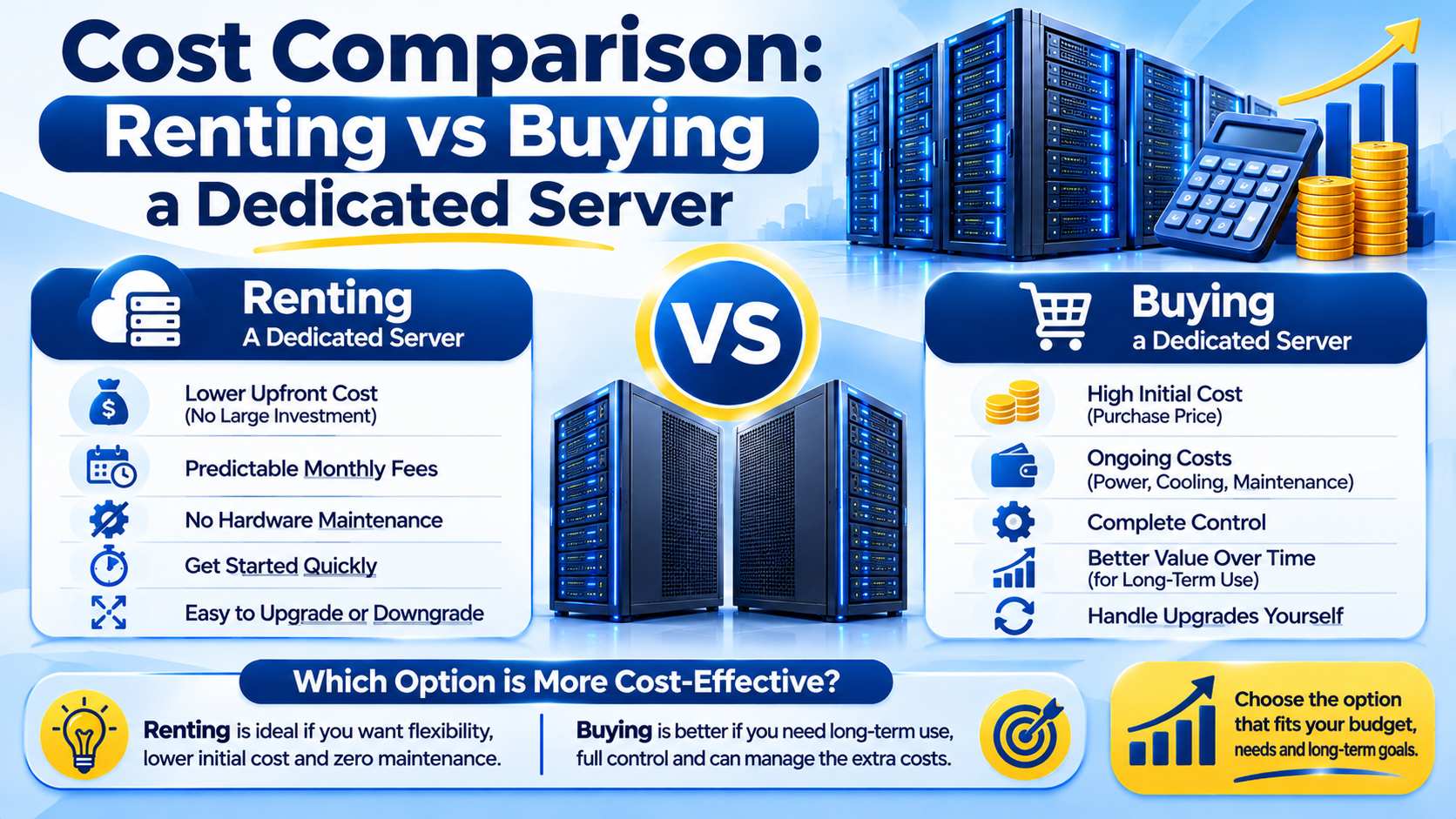
Cost is often the deciding factor when comparing dedicated server rental with purchasing hardware.
However, comparing a monthly rental fee with the purchase price of a server does not provide an accurate financial picture.
Businesses should calculate the total cost of ownership (TCO), which considers the initial investment and all expenses associated with operating the infrastructure.
Costs of Renting a Dedicated Server
With a rented dedicated server, most infrastructure expenses are included in the recurring service fee.
Typical expenses include:
- Monthly or annual server rental.
- Additional memory or storage upgrades.
- Managed server administration, if required.
- Backup services, if not included.
- Additional bandwidth or network services, depending on the package.
The predictable payment structure makes infrastructure expenses easier to forecast.
You also avoid directly investing in server room construction, cooling equipment, and physical hardware replacement.
However, you should check the provider’s service agreement for additional charges, minimum contract periods, bandwidth limits, and hardware support conditions.
Costs of Buying Server Hardware
Purchasing a server requires a larger initial investment. The purchase price is only one part of the overall expense.
Consider these cost categories:
1. Hardware purchase
You need to purchase the physical server, including processors, memory, storage drives, RAID controllers, and other required components.
2. Infrastructure setup
If you operate the hardware yourself, you need suitable space, power protection, cooling, physical security, and network infrastructure.
3. Electricity and cooling
Servers operate continuously and generate heat. Electricity consumption and cooling can become significant operating expenses, particularly when running multiple machines.
4. Network connectivity
You need reliable internet connectivity with sufficient bandwidth and appropriate redundancy for your applications.
5. Hardware maintenance
Replacement drives, power supplies, fans, memory modules, and other components can create additional expenses.
6. Technical personnel
Your business may need experienced system administrators and hardware technicians to maintain infrastructure, monitor equipment, and troubleshoot problems.
7. Hardware depreciation
Server equipment loses value over time. Its useful life depends on workload, hardware condition, vendor support, and business requirements.
8. Replacement and disposal
Eventually, hardware may need replacement or decommissioning. These costs should be considered when evaluating long-term ownership.
How to Calculate the Total Cost of Ownership
A fair comparison should consider both options over the same period, such as three or five years.
Rental cost:
Total rental cost = Monthly rental fee × Number of months + Additional service costs.
Hardware ownership cost:
Total ownership cost = Hardware purchase + Infrastructure setup + Operating expenses + Maintenance + Connectivity + Technical support − Residual value.
For a complete assessment, also consider financing costs, software licensing, insurance, shipping, installation, and the potential cost of downtime.
If you use colocation, include rack space, power consumption, cooling, bandwidth, remote hands, and any applicable service charges.
The purpose of this calculation is to compare the actual cost of operating the infrastructure rather than looking at the initial purchase price alone.
5. CAPEX vs OPEX: Understanding the Financial Difference
Another important consideration is how your business allocates its infrastructure budget.
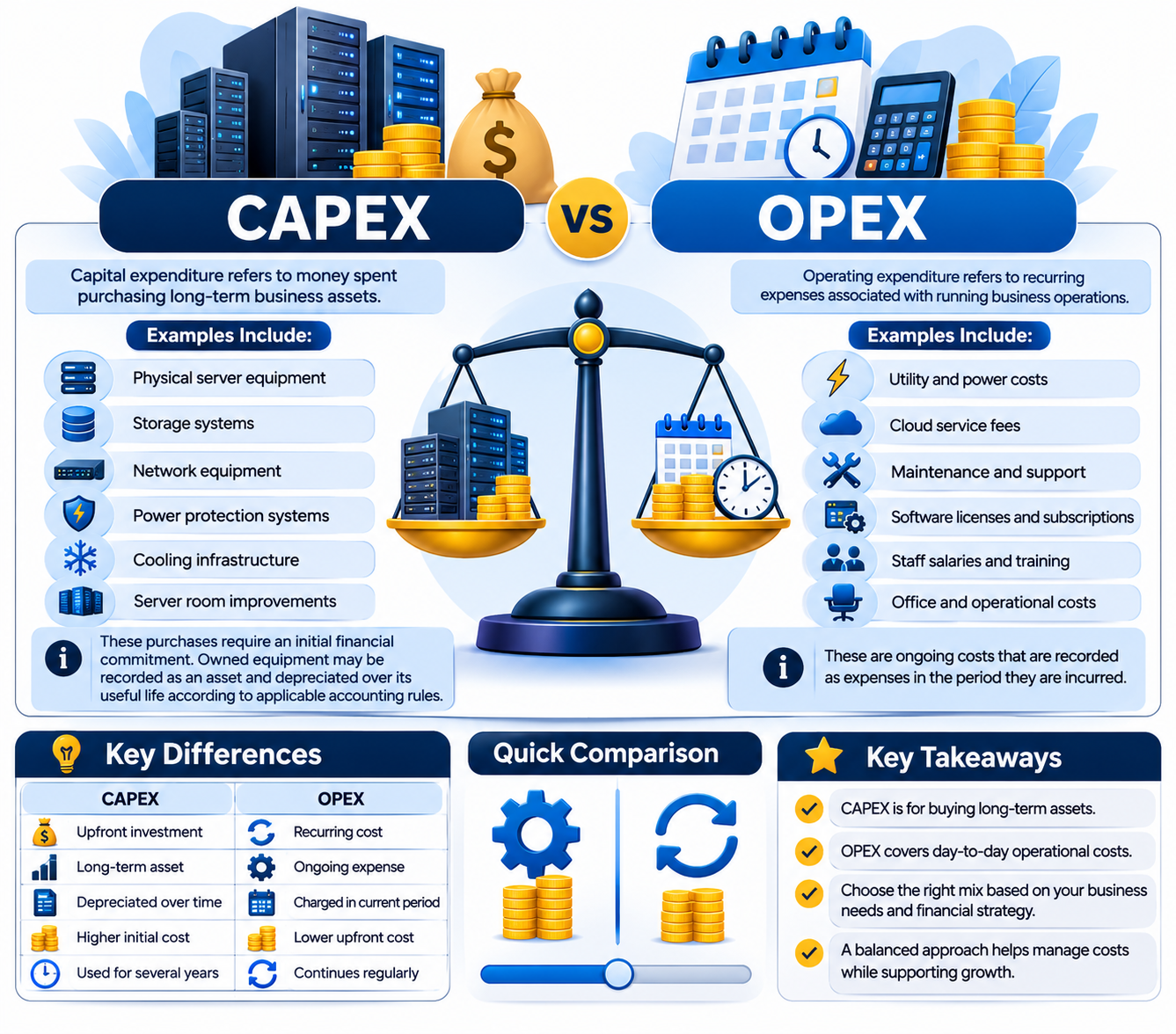
Dedicated server ownership generally involves capital expenditure (CAPEX), while server rental is commonly treated as an operating expense (OPEX), although actual accounting treatment depends on the contract and applicable accounting standards.
What Is CAPEX?
Capital expenditure refers to money spent purchasing long-term business assets.
When buying server hardware, CAPEX may include:
- Physical server equipment.
- Storage systems.
- Network equipment.
- Power protection systems.
- Cooling infrastructure.
- Server room improvements.
These purchases require an initial financial commitment. Owned equipment may be recorded as an asset and depreciated over its useful life according to applicable accounting rules.
What Is OPEX?
Operating expenditure refers to recurring expenses associated with running business operations.
For rented dedicated servers, OPEX commonly includes:
- Monthly server rental.
- Managed hosting services.
- Additional storage and bandwidth.
- Backup services.
- Technical support.
This model avoids purchasing the physical server and replaces the initial hardware investment with recurring service payments.
The choice between CAPEX and OPEX depends on your organization’s cash flow, budgeting preferences, accounting treatment, and long-term infrastructure strategy.
6. Advantages of Renting a Dedicated Server
Dedicated server rental is suitable for businesses that need dedicated computing resources without managing physical hardware ownership.
Lower Initial Investment
You do not need to purchase expensive enterprise server equipment before deploying your applications.
Instead, you pay a recurring fee and allocate available capital to other business activities.
This can be particularly useful for startups, agencies, and growing businesses.
No Direct Hardware Maintenance
The hosting provider generally handles covered hardware maintenance and replacement.
If a component fails, the provider follows its hardware support procedures rather than requiring your business to source and install replacement equipment.
The exact responsibilities depend on the service agreement.
Access to Professional Data Centre Infrastructure
Professional data centres provide power, cooling, network connectivity, and physical security.
Building and maintaining equivalent infrastructure independently can be expensive.
Easier Infrastructure Expansion
When your computing requirements increase, you can often upgrade your existing server or add additional dedicated servers.
This avoids the need to purchase and deploy physical equipment yourself, although available configurations and delivery times depend on the provider.
Predictable Operating Expenses
Monthly rental payments make infrastructure costs easier to forecast and manage.
Businesses can plan their hosting budgets without making repeated large hardware purchases.
7. Advantages of Buying Your Own Server Hardware
Although renting is convenient, owning server hardware can be appropriate for organizations with specific infrastructure requirements.
Complete Hardware Ownership
You own the physical equipment and control how it is configured and deployed.
This can be valuable when your applications require specific components or specialized configurations.
Greater Configuration Flexibility
Businesses can select processors, memory capacities, storage technologies, RAID configurations, and network components according to their requirements.
They can also decide when to upgrade or replace individual components.
Control Over Hardware Lifecycle
You decide when to upgrade, repair, repurpose, or retire your equipment.
This can be useful for organizations with established infrastructure teams and long-term hardware planning.
Potential Long-Term Financial Benefits
If your business operates servers continuously over an extended period, purchasing hardware may offer financial benefits compared with recurring rental payments.
However, these potential savings depend on utilization, maintenance, electricity, cooling, colocation, technical support, and replacement costs.
Suitable for Specialized Requirements
Some businesses need specific hardware configurations, including specialized storage systems, high-memory servers, or custom computing environments.
Owning the equipment can provide greater flexibility when standard rental configurations do not meet those requirements.
8. Server Colocation: A Third Option
Businesses do not necessarily have to choose between renting a dedicated server and operating their own server room.
Server colocation provides another option.
With colocation, you purchase and own the physical server but place it inside a third-party data centre.
The data centre typically provides:
- Rack space for your equipment.
- Electricity and cooling.
- Network connectivity.
- Physical security.
- Data centre environmental controls.
- Remote hands services, depending on the agreement.
Your business remains responsible for the server hardware, including procurement, configuration, maintenance, upgrades, and replacement, unless additional managed services are contracted.
Rental vs Ownership vs Colocation
| Infrastructure Model | Who Owns Hardware? | Who Provides the Facility? | Main Responsibility |
| Dedicated server rental | Hosting provider | Hosting provider | Customer manages software unless managed services are included |
| On-premises ownership | Your business | Your business | Your business manages hardware and facility |
| Server colocation | Your business | Third-party data centre | Your business manages hardware; facility operator manages the data centre environment |
Colocation is particularly useful for organizations that want hardware ownership without investing in their own data centre facilities.
However, it does not eliminate hardware maintenance or infrastructure management responsibilities.
9. When Should You Rent a Dedicated Server?
Renting is generally the more practical choice when your business wants dedicated computing resources without taking responsibility for physical hardware ownership.
Consider renting if:
- You are launching a new online business or application.
- You want to avoid a large upfront hardware investment.
- Your infrastructure requirements may change.
- You do not have an in-house hardware maintenance team.
- You need access to professional data centre facilities.
- You prefer predictable monthly infrastructure expenses.
- You manage websites, ecommerce stores, applications, or databases.
- You need to deploy additional servers without purchasing physical equipment.
For businesses in Pakistan, dedicated server hosting can simplify access to professional hosting infrastructure without requiring a separate investment in server facilities.
10. When Should You Buy Your Own Server Hardware?
Purchasing hardware may make more sense when your organization has established infrastructure requirements and the resources to operate its own equipment.
Consider buying if:
- Your business has an existing data centre or suitable server room.
- You have an experienced infrastructure management team.
- You need specialized hardware configurations.
- You expect to use the equipment over an extended period.
- Your organization requires direct physical control over its equipment.
- You have a clear hardware replacement and maintenance strategy.
- Your financial analysis supports the investment.
If you do not have your own data centre, colocation can provide an alternative. It allows you to retain hardware ownership while using an external facility for power, cooling, rack space, and connectivity.
11. A Practical Example: Choosing Infrastructure for a Growing Business
Consider a growing software or hosting business that needs dedicated computing resources for websites, databases, customer applications, and internal services.
It has two main options.
Option A: Rent dedicated servers
The business rents the required servers from a hosting provider and pays a recurring monthly fee.
It avoids purchasing equipment, arranging data centre facilities, and directly managing hardware replacement.
This approach is particularly practical when infrastructure requirements are changing or the business does not have a dedicated hardware operations team.
Option B: Purchase hardware and use colocation
The business purchases enterprise-grade servers and places them in a third-party data centre.
It pays for the hardware upfront and continues paying for rack space, power, cooling, connectivity, and additional services.
It also needs to manage hardware maintenance, replacement components, and the equipment lifecycle.
This approach may be suitable for an established organization with predictable workloads, sufficient capital, and experienced technical personnel.
Neither option is automatically cheaper. The business should compare the total cost over its expected usage period and consider the operational responsibilities associated with each model.
12. Common Mistakes When Comparing Rental and Ownership
Businesses sometimes make infrastructure decisions based on incomplete cost comparisons.
Avoid these common mistakes:
Comparing monthly rental with purchase price alone
A server purchase price does not include electricity, cooling, connectivity, maintenance, staffing, or replacement expenses.
Ignoring hardware failures
Owned hardware can experience component failures. Businesses must account for replacement costs and the operational impact of downtime.
Underestimating infrastructure requirements
A server requires more than electricity and an internet connection. Appropriate cooling, power protection, physical security, and network infrastructure are also important.
Ignoring future scalability
A server that meets today’s requirements may create limitations when workloads increase. Consider future processing, memory, and storage requirements before investing.
Overlooking technical expertise
Hardware ownership requires people who can maintain and troubleshoot the equipment. These operational responsibilities should be included in the financial comparison.
Assuming rental includes complete server management
Hardware maintenance and software administration are different responsibilities. Always check whether operating system support, security updates, monitoring, and application management are included in the hosting package.
Frequently Asked Questions
